
DeFi Fixed Rate Loans: Lock in 2-3% Borrow on Mopho Midnight, Tenor, & TermMax
TL:DR:
Fixed-rate lending finally landed on Base. Morpho Midnight, Tenor, and TermMax all let you lock in a rate for a set term — no more watching it drift while you sleep.
Every major money market — Aave, Compound, Morpho Blue — reprices your rate every block. Fine for idle cash, brutal for a loop or carry trade, since rates spike exactly when everyone’s rushing for the exit.
Right now there’s a reward program paying double-digit APR just to lend USDC — but it’s on a countdown. There’s also a rarer setup where you can borrow against your own collateral for less than that collateral is earning you.
These loans have a maturity date. Miss it, and you get liquidated even if your position was perfectly healthy.
Anyone running a leveraged or looped trade, sitting on yield-bearing collateral, or with an opinion on where rates go from here.
Fixed-Rate Lending in DeFi: Tenor, Morpho Midnight & TermMax
Every major DeFi money market — Aave, Compound, Morpho Blue — shares the same quirk: your interest rate re-prices every block. That’s fine for parking idle capital. It’s terrible for anything that depends on a spread, because variable rates spike at exactly the moment everyone else is unwinding, and your profitable loop becomes a losing one overnight.
TradFi solved this centuries ago with fixed-term, fixed-rate debt — the zero-coupon bond. This month, that primitive finally arrived on Base in earnest. On 21 July 2026, Morpho launched Midnight, its fixed-rate, fixed-term protocol, with Tenor — a startup founded by ex-Morpho, Notional and Google engineers, seeded by Variant and Coinbase Ventures — as the trading venue on top.
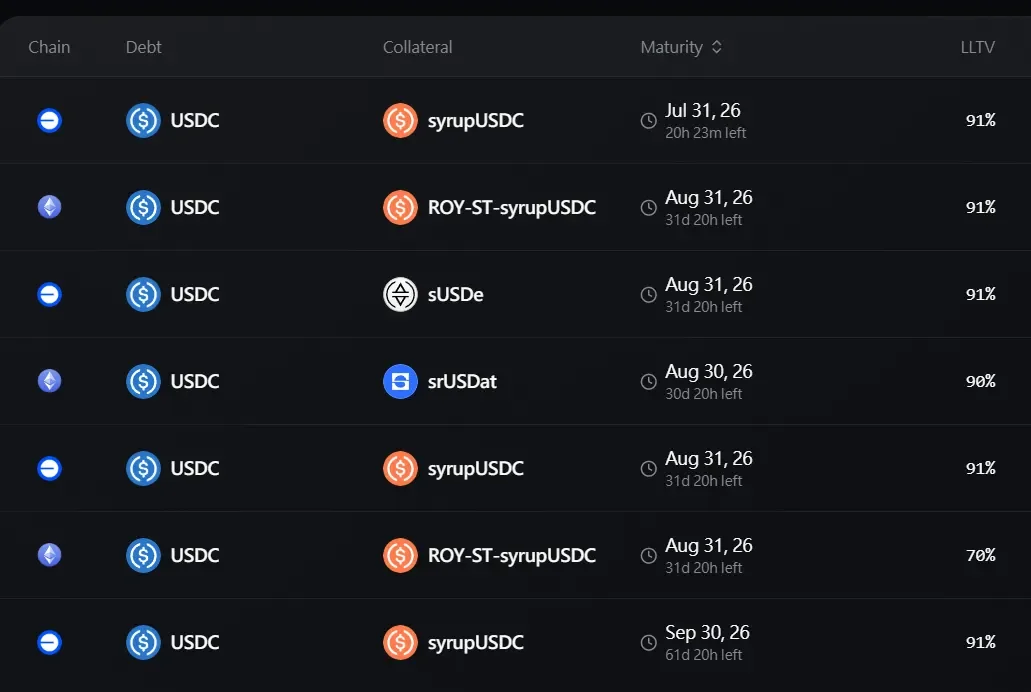
To bootstrap liquidity, Tenor is paying lenders MORPHO rewards that were quoting around 16% APR at the time of writing. Meanwhile TermMax, a fixed-rate AMM live since 2024, runs 77 markets across 8 chains — including a Base market that lets you borrow USDC against sUSDe at a rate locked below sUSDe’s own yield.
This guide covers how these protocols actually work, when fixed rate is the right tool, the yield opportunities live right now, and the ways people lose money here.
How it works
The shared primitive
Strip away the branding and all three protocols sell the same object: a zero-coupon bond. A fixed-rate loan is a claim on exactly 1 unit of the loan token (say, 1 USDC) at a set maturity date, bought today at a discount. The rate is the discount:
rate over the term = 1 / price − 1
Pay $0.9967 today for $1.00 in 32 days and you’ve locked ~3.8% annualised. That one formula is the entire mechanism; orderbooks, AMMs and token tickers are just machinery for discovering the price. Two consequences follow directly, and they explain almost every rule below: the loan ends — at maturity the debt is due in full, and a borrower who does nothing gets liquidated even if the position is healthy; and exiting early means selling the bond — you can only leave before maturity by selling your position at whatever the market rate is then, taking a mark-to-market gain or loss.
Morpho Midnight — the settlement layer
Midnight is Morpho’s fixed-rate protocol, launched on Base alongside (not replacing) the variable-rate Morpho Blue.
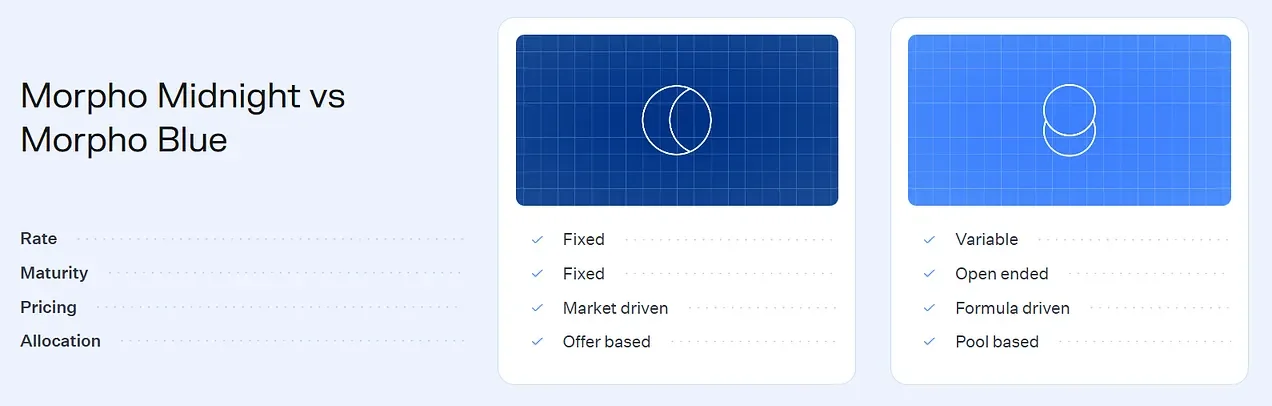
Each market is isolated and immutable: one loan token, one maturity date, a fixed set of accepted collaterals each with its own LLTV and oracle. Lenders hold credit units — a claim on one loan token at maturity; borrowers hold debt units — an obligation to repay one. Units with the same maturity are fungible regardless of when the position was opened, which is what keeps liquidity concentrated instead of fragmented.
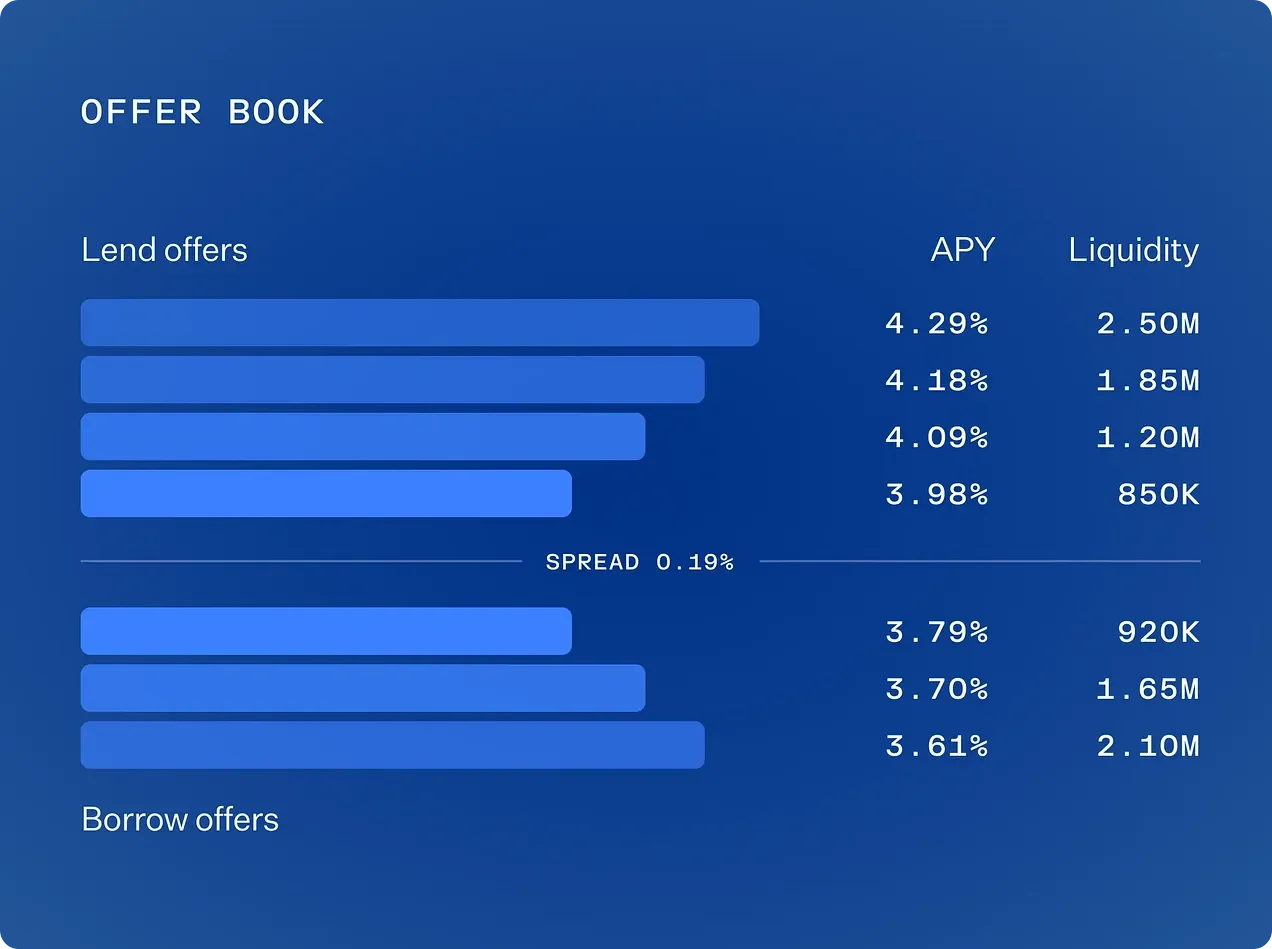
Price discovery happens through an offer book: makers sign offers off-chain (price and size), takers settle them on-chain atomically. Crucially, makers don’t lock capital while quoting — funds only move at settlement — so a lender can earn variable yield on Morpho Blue while simultaneously quoting a fixed rate on Midnight.
Two protocol fees exist: a settlement fee paid by the taker (capped around 50bp annualised) and a continuous fee paid by lenders (capped at 1% annualised, fixed at your entry rate). Midnight shipped deliberately minimal: no lender vaults, no auto-rollover, no SDK yet. That’s why you use it through Tenor.
Tenor — the trading layer

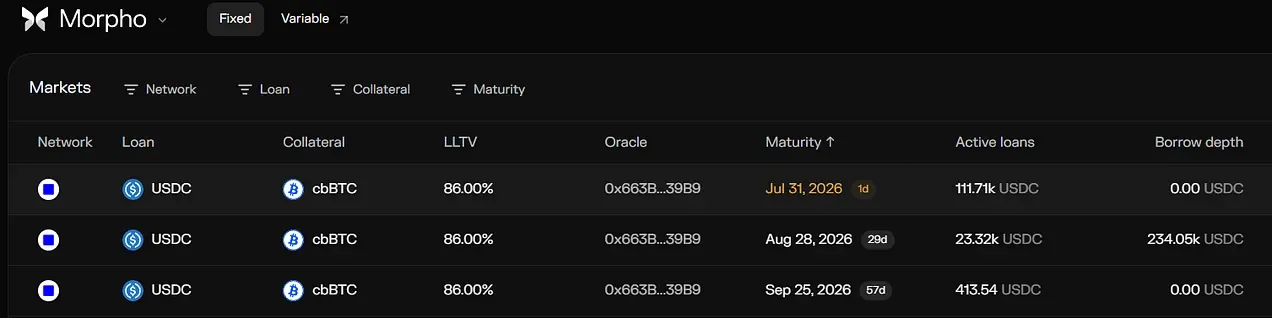
Tenor is neither a fork of Midnight nor just a frontend — it’s a periphery protocol: its own contracts wrapped around Midnight’s core, settling on the same liquidity. Three markets are live on Base — cbBTC/USDC, WETH/USDC, cbETH/WETH — on four-week renewal cycles with initial terms up to about five months. Tenor charges no fees of its own.
What Tenor adds is the practical toolkit. An orderbook UX with 0.25% rate ticks, market and limit orders, and a router that fills across multiple offers in one transaction. “Earn while you wait”: a resting lend offer parks your capital in a Morpho Vault V2 earning the variable Blue rate, then converts atomically into the fixed position the instant a borrower takes your offer — you’re never idle.
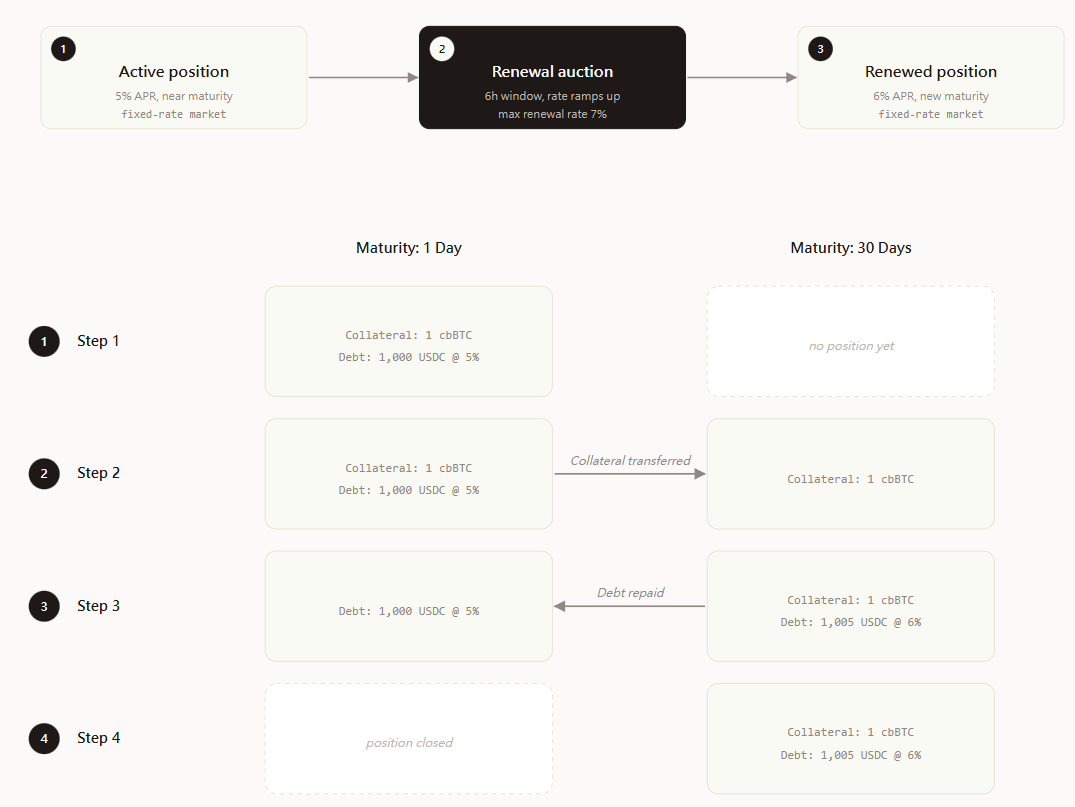
And auto-renewal, the only maturity autopilot among the three protocols: opt in, set a maximum rate, and independent keepers roll your position at maturity via a Dutch auction (the rate offered to keepers ramps from 0% toward your max over roughly a day, so competition usually settles it near market). If no fixed offer clears under your max, the position falls back to a variable-rate Blue market rather than being liquidated.
TermMax — the fixed-rate AMM
TermMax is unrelated to the Morpho stack: a standalone protocol live since 2024, roughly $34M TVL across Ethereum, Base, Arbitrum, BSC and four other chains.
Three tokens explain the whole system. FT is the zero-coupon bond — an ERC-20 redeeming 1:1 for the debt token at maturity. XT is the interest leg (1 FT + 1 XT = 1 debt token; XT expires worthless). GT is an NFT wrapping a borrower’s position: collateral locked, debt owed.

A lender deposits 1,000 USDC at 5% for a year and immediately receives 1,050 FT — principal plus the entire term’s interest, minted upfront — redeemable for 1,050 USDC at maturity, or sellable early on the AMM at the prevailing rate.
A borrower locks collateral into a GT and mints FT against it; the whole term’s interest is fixed into the debt from the first second — no accrual, no rate resets. Early repayment carries no penalty, and there’s a useful trick: since debt is denominated in FT, buying discounted FT off the market and repaying with those is cheaper than repaying at par. Quotes come instantly from a Uniswap-V3-style AMM whose liquidity is concentrated in rate space by curators and vaults, rather than from a counterparty search.
TermMax’s real edge is yield-bearing collateral: it’s the only venue of the three accepting Pendle PTs, sUSDe, LSTs and RWAs, with a one-click Leverager that flash-loans the debt token, buys collateral, and wraps the whole loop into a single atomic transaction. One caveat: fees are front-loaded on top of the quoted APR (borrow fee ≈ [6%×10% + rate×3%] × days/365, charged on the full borrowed amount), which matters at leverage — the math below accounts for it.
Why it matters — when to use fixed rate
Carry trades. If you borrow at X to earn Y, the trade is the spread — and on variable-rate venues, X blows out precisely when markets stress and everyone unwinds together. Fixing the borrow leg converts a fragile trade into arithmetic. This is the missing piece looping strategies always had.
Known cost of funds. Borrowing against BTC or ETH without selling — for taxes, expenses, or redeployment — at a rate you know for the entire term, immune to utilisation spikes.
A view on rates. If you think yields are heading down, lending fixed at today’s rate for the longest available term is a directional trade you simply cannot express in a variable pool, where your rate falls with everyone else’s.
Incentives. New fixed-rate venues pay you to show up. Tenor is distributing MORPHO to lenders; TermMax runs an XP program ahead of its token (vault deposits earn 30x, lending FT 15x, leveraged positions only 2x — worth knowing if the airdrop is part of your thesis).
If none of these apply — you’re just parking stables with no rate view — a variable vault remains simpler, deeper and more liquid.
Risk warnings
Maturity is a hard deadline — the #1 way to lose money here. On all three protocols, a position not repaid or renewed at maturity gets liquidated even if perfectly healthy. TermMax opens a 2-hour liquidation window with a 10% penalty (5% liquidator, 5% protocol), then moves to physical delivery. Midnight’s post-maturity penalty ramps from zero to maximum within 60 minutes. Tenor’s auto-renewal is the only autopilot — use it; everywhere else, set two alarms.
Exit liquidity is thin. These books are weeks old and shallow — the TermMax sUSDe market has recorded zero matched fills in three months, and its entire borrow side is one ~$500k vault order. Exiting early means finding a bid at the prevailing rate. Assume you hold to maturity and size accordingly (keeping borrowed size under ~$100k in that market is prudent).
Bad debt is shared. On Midnight, if a liquidation can’t cover a borrower’s debt, the shortfall is socialised instantly across every lender in that market — no seniority, no delay. On TermMax, the lender backstop is physical delivery: FT holders receive a pro-rata mix of cash and collateral tokens, so you may end up holding sUSDe instead of USDC.
Rewards are temporary and dilutive. Tenor’s MORPHO schedule ends the week of 31 Aug 2026 with no announced extension; the quoted APR falls as more capital queues; and you carry MORPHO price risk between weekly claims. Yield built on emissions is a trade with an expiry date.
Contract risk is real. Tenor launched this month with 3 of its 5 security reviews still in progress (its bug bounty is $200k versus $2.5M on the underlying Morpho contracts). Midnight itself is new code. TermMax is older and Spearbit/Cantina-reviewed, but its Base deployment holds only ~$1.2M. Size positions as if the code is young — because it is.
Know your oracle. Tenor’s cbBTC market uses a Chainlink market-price feed (86% LLTV, max ~4.4% liquidation penalty) — a sharp BTC wick can liquidate you. TermMax’s sUSDe market uses an exchange-rate feed: secondary-market sUSDe price wobbles don’t touch your LTV at all, and since the sUSDe/USDe rate only accrues upward, your LTV drifts down over the term. The residual tail is a genuine Ethena loss event — which is precisely the scenario where leverage hurts most.
