
Fixed-Rate Borrowing on FiRM: Here's How it Works
TL;DR
FiRM is a fixed-rate lending protocol on Ethereum with $87.7M in TVL and $70M borrowed
You buy DBR tokens upfront to lock your borrow cost — currently ~4.69% fixed, unlimited duration
Your collateral sits in an isolated personal escrow — not pooled, not rehypothecated, not lendable
One-click leverage up to 12.5x on stablecoin positions via the Accelerated Leverage Engine
The ysyBOLD market currently pays 3.67% in Merkl borrow rewards, cutting the effective fixed rate to just 1.02% — ending Dec 12
How Fixed Rates Actually Work in DeFi

Every major lending protocol — Aave, Compound, Morpho — charges a variable rate. You deposit collateral, borrow, and hope the rate stays reasonable. It usually doesn’t. A borrow at 3% in the morning can be 8% by evening if utilization spikes.
FiRM works differently. Instead of paying interest continuously at a floating rate, you buy a token called DBR (DOLA Borrowing Right) upfront.
The mechanic:
1 DBR = the right to borrow 1 DOLA (Inverse’s stablecoin) for one year
While your loan is open, your DBR balance streams down continuously — like a subscription ticking away
If you borrow 5,000 DOLA, you consume ~13.7 DBR per day
Your cost is whatever you paid for DBR on the open market — currently ~$0.047 per token, which translates to a 4.69% annualized fixed rate
The key insight: your rate is locked at the moment you buy DBR. If market rates spike to 10% tomorrow, you’re still paying 4.69%. If rates drop to 2%, you overpaid — but you had certainty.
This is not a fixed-term loan. Unlike protocols that lock you into 30- or 90-day windows, FiRM loans run indefinitely. When your DBR runs low, you buy more to keep the loan open. Your rate on the new DBR reflects current market pricing, but your existing position’s cost is already paid.
The catch: if your DBR balance hits zero while you still have debt, anyone can trigger a “forced replenishment” — buying DBR on your behalf at a punitive 54.75% APR and adding the cost to your debt. Set a reminder to top up.
Your Collateral Sits in Its Own Vault
Most lending protocols pool your collateral with everyone else’s. Your wstETH sits next to thousands of other deposits in one big contract. If something goes wrong with that contract or another collateral type in the pool, your position is at risk.
FiRM uses Personal Collateral Escrows (PCE). When you deposit, the protocol deploys a dedicated smart contract that holds only your collateral, only that asset type. Your wstETH escrow is completely separate from your sUSDe escrow, and each is separate from every other user’s escrow.
What this means in practice:
No rehypothecation. Your collateral is never lent out to other borrowers. It sits in your escrow until you withdraw it.
Isolated exploit risk. If a vulnerability is found in the sUSDe market, it cannot cascade into the wstETH market. Each market is a separate contract.
Governance rights preserved. If you deposit CVX as collateral, you can still vote on Curve proposals. The escrow holds your tokens but doesn’t strip their functionality.
This is a fundamentally different security model from pooled lending. It doesn’t eliminate smart contract risk — your individual escrow contract could still have a bug — but it prevents the cascading failures that have hit pooled protocols in the past.
One-Click Leverage: The Accelerated Leverage Engine
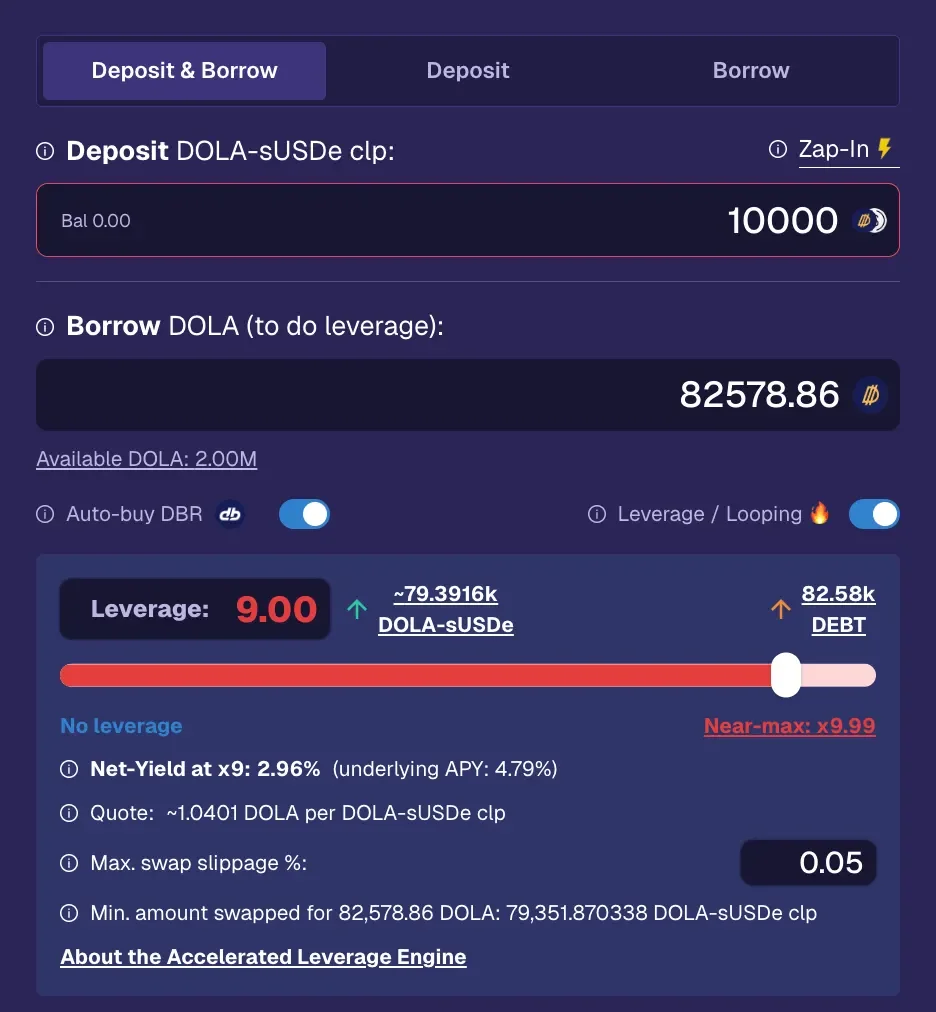
Leverage in DeFi lending normally means looping: borrow stablecoins → swap to collateral → redeposit → borrow more → repeat. This takes 8–10 separate transactions, 15–20 minutes of gas costs, and a lot of patience.
FiRM’s Accelerated Leverage Engine (ALE) does the entire loop atomically in one transaction:
Flash-mints DOLA
Swaps it to your chosen collateral via approved routers (Enso or KyberSwap)
Deposits the collateral into your escrow
Borrows DOLA to repay the flash mint
Repeats until your target leverage is reached
No protocol fee. You pay gas and swap slippage, but Inverse charges nothing for ALE.
Available leverage depends on the market. Stablecoin positions allow up to 12.5x. ETH and BTC markets allow up to 6.67x. The collateral factor (how much you can borrow against your deposit) determines the maximum — an 85% CF means each loop retains 85% of the prior step’s value, compounding up to the theoretical max.
The core trade: you’re leveraging yield-bearing collateral against a known, fixed borrow cost. If your collateral yields more than your effective rate, every turn of leverage adds to your net return. If it yields less, leverage works against you.
A Worked Example: ysyBOLD on FiRM
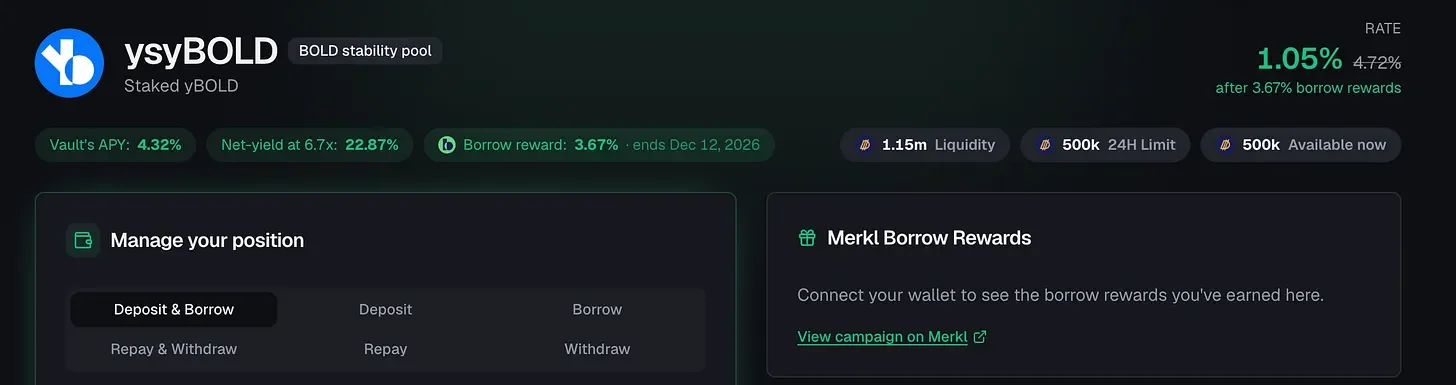
Let’s make this concrete with a position you can examine today.
ysyBOLD is a vault token representing a position in Liquity’s BOLD stability pool. The stability pool earns yield from liquidations and borrower interest — currently paying 5.00% APY. The vault auto-compounds this yield.
On FiRM, ysyBOLD is listed as collateral with:
Collateral factor: 85%
Max leverage: 6.67x
Oracle: Chainlink + CurveLP (pessimistic pricing)
Current TVL: $1.03M
DOLA liquidity: $1.15M
24H borrow limit: 500K DOLA (ramping up — currently ~95K available, resets daily)
Min debt: 3K DOLA
The incentive that changes the math:
The ysyBOLD market currently offers a 3.67% Merkl borrow reward, ending December 12, 2026. This reward is paid to borrowers on top of the vault yield, effectively subsidizing your borrow cost.
The base fixed rate is 4.69%. After the 3.67% borrow reward, your effective fixed rate drops to 1.02%.
That transforms the spread. Instead of earning 5.00% against a 4.69% cost (a thin 31bp margin), you’re earning 5.00% against a 1.02% effective cost — a 3.98% spread per turn of leverage.
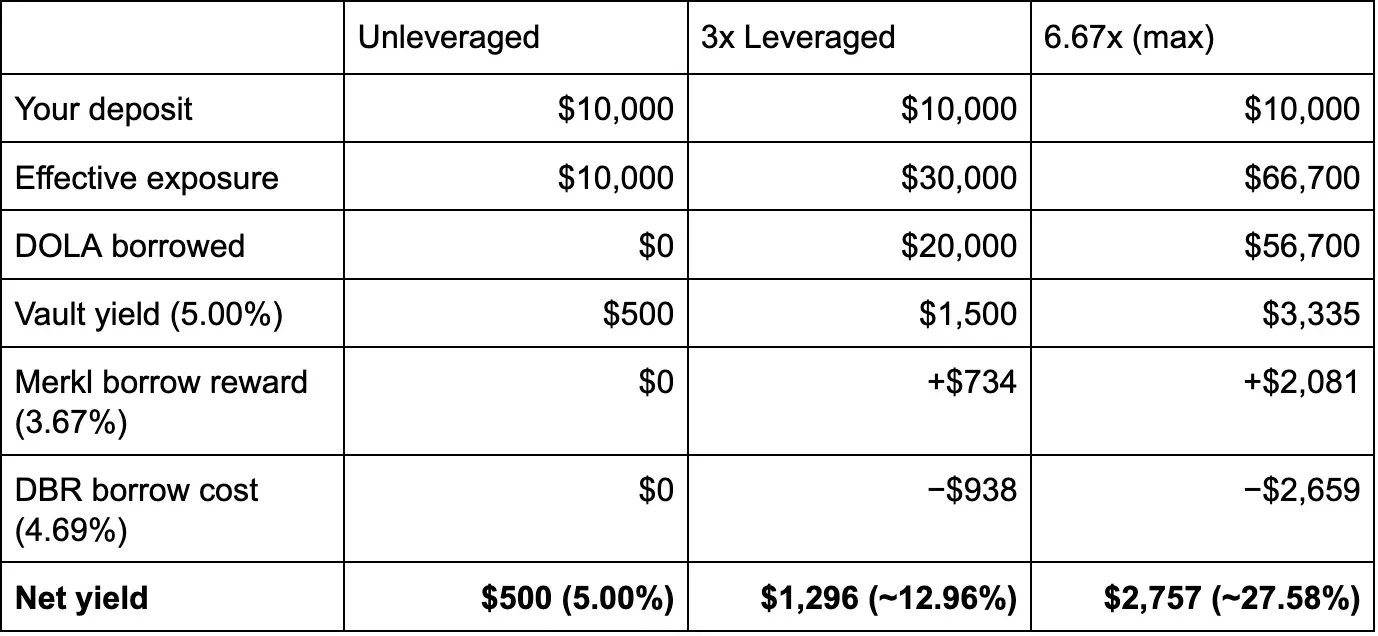
At 3x leverage, you’re earning nearly 13% on a stablecoin-denominated position with a fixed, known borrow cost. At the max 6.67x, it reaches 27.58%.
Why this matters beyond the numbers:
The borrow cost is fixed. If BOLD stability pool yields rise (they fluctuate with liquidation activity), your net return improves while your cost stays locked. On a variable-rate protocol, rising yields would likely pull borrow rates up with them, eating the spread.
The Merkl borrow reward is temporary — it ends December 12, 2026. After that, the effective rate reverts to the full 4.69%, compressing the spread back to 31bp per turn. This is a time-limited window.
The borrow limit resets daily at 500K DOLA. You may need to enter across multiple days for larger positions, but the capacity is growing.
Risks specific to this position:
Incentive expiry — the 3.67% Merkl reward ends Dec 12, 2026. After that, the position economics change significantly. Plan your exit or deleveraging before the incentive drops off
New market — ysyBOLD was recently added to FiRM, with borrow capacity still ramping up
BOLD stability pool risk — yield depends on liquidation volume; quiet markets mean lower returns
DOLA liquidity — $1.15M available in this market; large positions face exit friction
Leverage amplifies losses — a 10% drop in ysyBOLD value at 3x means 30% position loss
< Farm 20% Fixed Yield on Liquity’s yBOLD on Inverse>
What Can Go Wrong
Every leveraged lending position shares the same failure modes.
Here’s what’s specific to FiRM:
Liquidation. When your debt exceeds your collateral value × collateral factor, anyone can repay your debt and seize your collateral (plus a ~5% bonus). At 5x leverage on a stablecoin position, a ~5-8% collateral decline can trigger liquidation. At 12.5x, it takes less than 2%. Stay 10-15% below your max LTV.
DBR depletion. Your DBR balance ticks down every second. If it hits zero, forced replenishment kicks in at 54.75% APR — roughly 10x the normal rate — and the cost gets added to your DOLA debt. Set a calendar reminder. Buy DBR with buffer.
DOLA depeg. DOLA trades at $0.9966 today. If it depegs significantly below $1, your borrowed DOLA is worth less than your debt implies. The protocol has mechanisms to maintain the peg, but no stablecoin is risk-free.
Smart contract risk. FiRM has been audited and uses PCE isolation, but the protocol interacts with Curve, Convex, Stake DAO, Yearn, and multiple stablecoin protocols. Each integration adds a contract surface. Nexus Mutual offers coverage for FiRM — consider it for larger positions.
Gas costs. This is Ethereum mainnet. Setting up a leveraged position via ALE can cost $50-200+ depending on network conditions. Your position size needs to justify the setup and eventual unwind costs. Below $5,000, the gas-to-yield ratio starts to break down.
How to Execute
Setting up a position (ysyBOLD example):
1. Get your collateral. You need ysyBOLD tokens — deposit BOLD into the yBOLD stability pool vault, or use FiRM’s Zap-In feature to convert from other assets directly
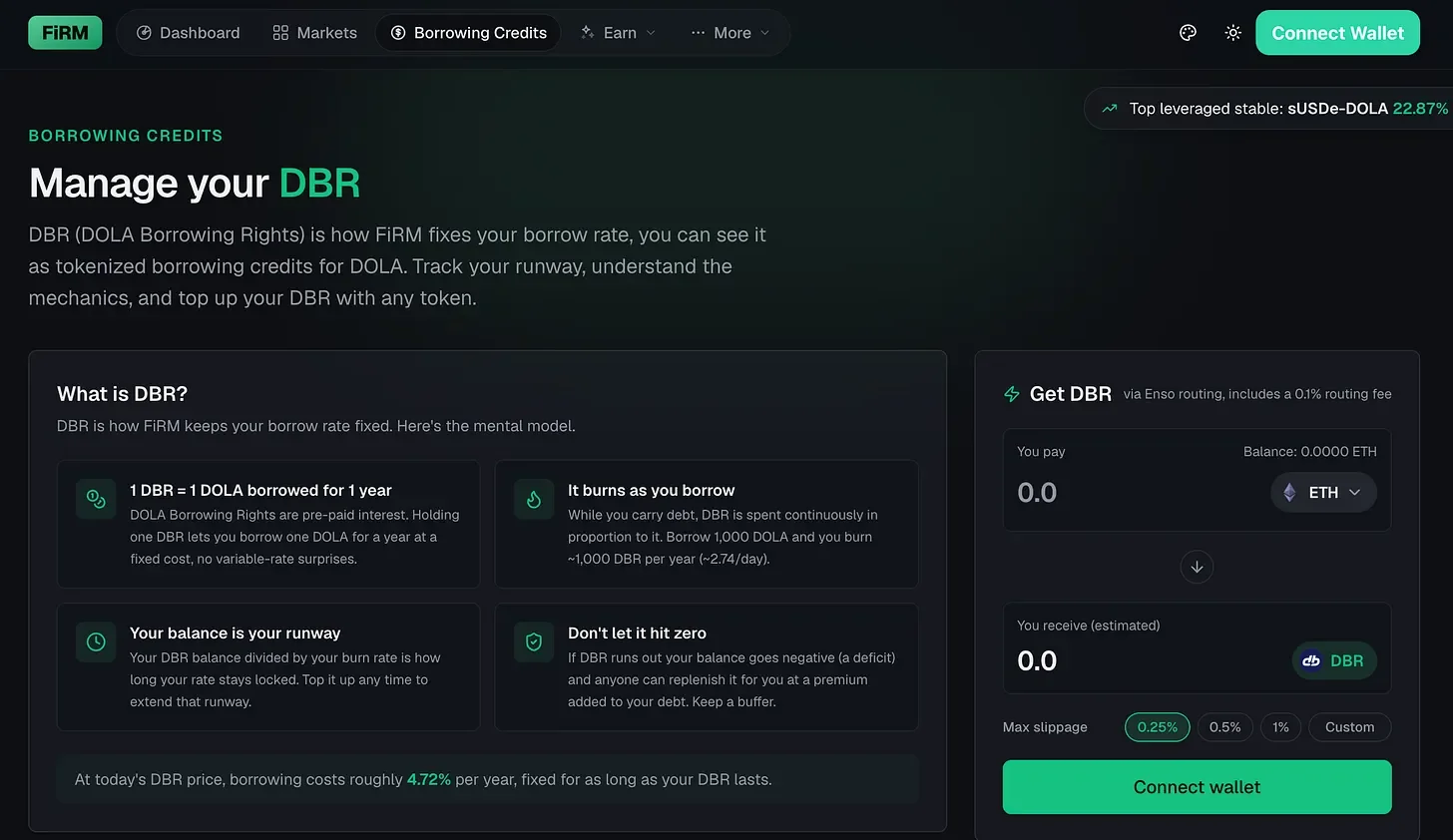
2. Buy DBR. Go to the FiRM interface → “Borrowing credits.” → “Get DBR.” Purchase enough to cover your expected loan duration. For a 10,000 position at 3x, you’re borrowing ~20 K DOLA → need ~20,000 DBR per year. At 0.047,that’s~940 in DBR. Alternatively, use the Auto-buy DBR option, which adds the cost to your loan.
3. Deposit collateral. Go to the ysyBOLD market → Deposit & Borrow tab → enter your ysyBOLD amount
4. Set leverage. Toggle the Leverage checkbox → select your target multiple (start conservative: 3x for ~13% net) → review the summary showing your effective position, borrow amount, and estimated net APY
5. Execute. Approve and confirm. ALE handles the looping atomically. One transaction.
Note on borrow limits: The ysyBOLD market has a 500K DOLA daily borrow limit that resets each day. If you need to borrow more than what’s currently available, check back the next day when the limit resets.
Monitoring:
DBR balance: Check weekly. Top up when it drops below 30 days of runway
Health factor: Available on the FiRM dashboard. Stay above 1.15 minimum; 1.3+ is comfortable
Underlying yield: Check if the vault’s APY has changed. If it drops below your effective borrow cost (1.02% with incentive, 4.69% without), your leverage is working against you
Incentive expiry: Mark December 12, 2026 in your calendar. Before that date, reassess whether the position still makes sense at the full 4.69% rate
Merkl rewards: Borrow rewards are distributed via Merkl — connect your wallet on the FiRM market page to see accrued rewards
Unwinding:
ALE works in reverse. One-click deleverage swaps your collateral back to DOLA, repays your debt, and returns remaining collateral. Same gas considerations apply.
Data as of October 13, 2026. Rates, TVL, and liquidity change continuously. Verify live figures on inverse.finance/firm before entering any position. This is not financial advice.
