
TL;DR
If you LP on Uniswap, arbitrage bots trade against you every time your pool’s price goes stale. On many volatile pairs, that costs you more than you earn in fees.
A prop AMM takes its price from an outside feed and quotes around it. Arbs can’t trade against a stale price because the price is never stale. Until now, every prop AMM ran on its own team’s capital.
Metric is the first to open it up. A price provider supplies the feed, a curator sets the pool, and anyone can LP. LPs earn the spread instead of a swap fee.
Early evidence is good. Castle Labs measured Metric WETH/USDC LPs at +0.44 bps per dollar traded, against −1.01 bps for Uniswap v3 (Oct 15–26).
The risks are real: inventory risk in a trending market, trust in the curator and the feed, fee shares that can change with no time lock, young contracts, and a mostly anonymous team.
<Explore LPs on Metric>
Why LPs Should Care
If you’ve LP’d on Uniswap, you’ve been paying arbitrage bots. Metric is built to stop that, and it’s already handling serious volume.
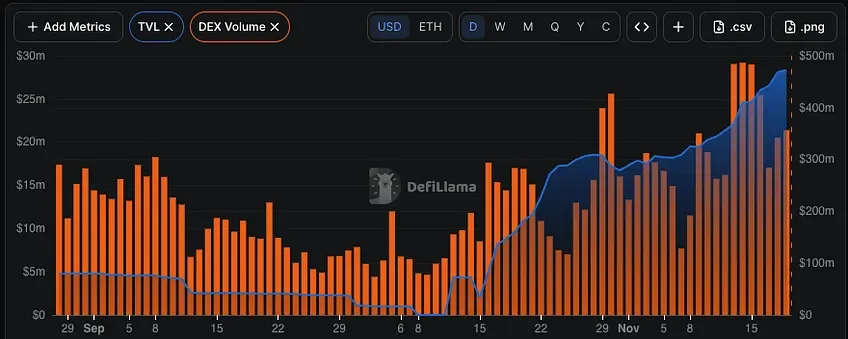
Metric did more than $8 billion of volume in its first month on more than $25 million of TVL, including one day above $600 million (team figures, Nov 15). DefiLlama comes close: $21.51M of TVL on Nov 12 and $7.3B of volume over 30 days. Either way, every dollar in the pools traded about 300 times in a month.
Most of that is stablecoins: the two USDC/USDT pools (Ethereum and BNB) did $3.2B of the $5.0B that went through the 15 largest pools in the last 30 days. But the WETH/USDC pool on Ethereum also turned over $346M on $3.2M of TVL. An AMM can’t usually do that without its LPs paying for it.
Why Uniswap LPs Lose to Arbs
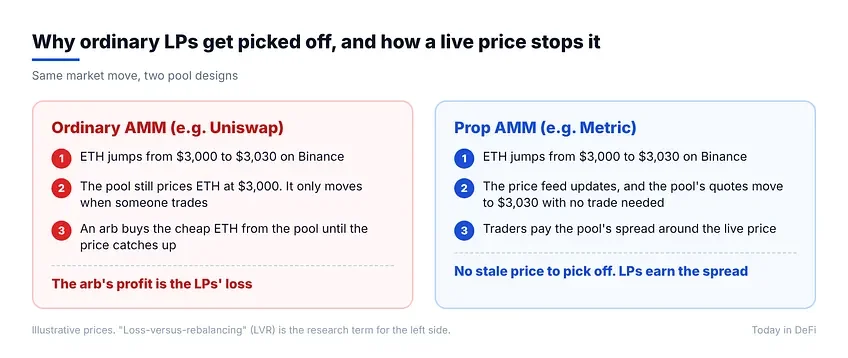
On Uniswap, the pool sets its own price, and it only moves when someone trades. When ETH moves on Binance, the pool is briefly wrong. An arbitrageur buys the cheap side until it matches, and the arb’s profit is the LPs’ loss. Researchers call this LVR (loss-versus-rebalancing).
Concentrated liquidity (Uniswap v3) makes it sharper. A narrow range earns more fees per dollar, but it also puts more of your capital at the exact price arbs trade against. And once the price leaves the range, you stop earning.
So the question for LPs has always been whether swap fees beat what the arbs take. On a lot of volatile pairs, they don’t.
The Fix LPs Couldn’t Use Until Now
A proprietary (prop) AMM flips the design. The price comes from an oracle or a market maker’s own feed, and the pool quotes a bid and ask around it. When ETH moves, the quotes move with it, with no trade needed, so there’s no stale price to pick off.
Prop AMMs already dominate where they run. BisonFi (about 40%) and Tessera (about 20%) lead Solana’s prop AMMs, and FermiSwap handles about 60% of Ethereum’s prop AMM volume. The catch is timing: the price update has to land before the swaps in each block, or the LP gets picked off anyway. That’s cheap on Solana and harder on Ethereum, where gas makes frequent updates expensive.
Until Metric, every one of them ran on its own team’s money, for three reasons:
The edge is secret. A fast private feed and per-trade pricing make the model work, and publishing them gives away the edge.
Open oracle pools have a known weak spot. If the oracle drifts from the real price, arbs trade against LPs at the wrong price. DODO tried an open oracle pool in 2020 and ran into exactly this.
Outside LPs create conflicts. An operator can keep the good flow and leave the toxic flow to LPs. Taking outside money also starts to look like running a fund.
How LPing on Metric Works
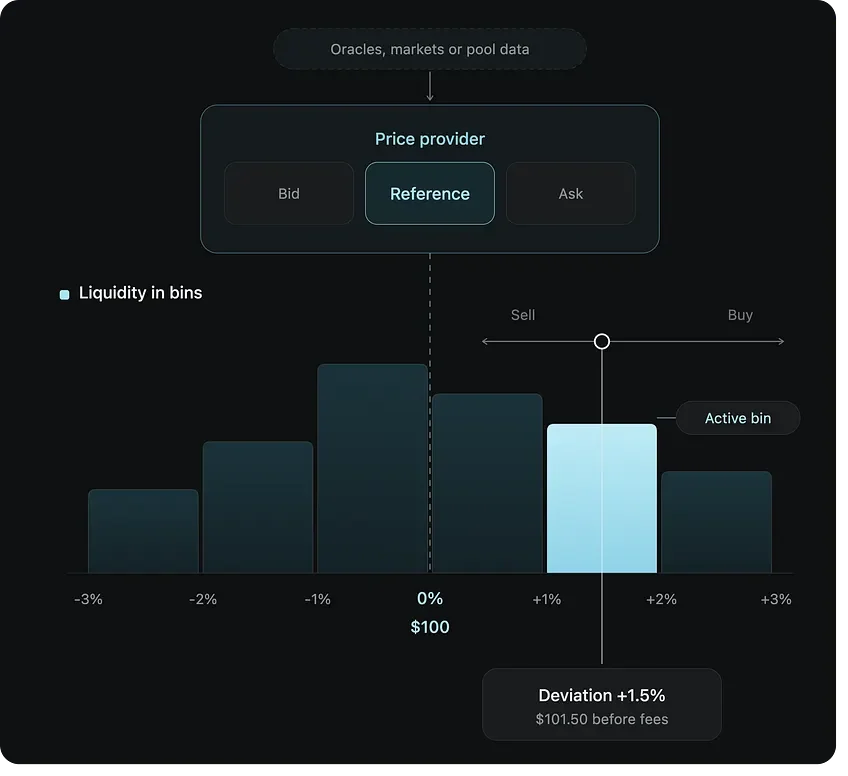
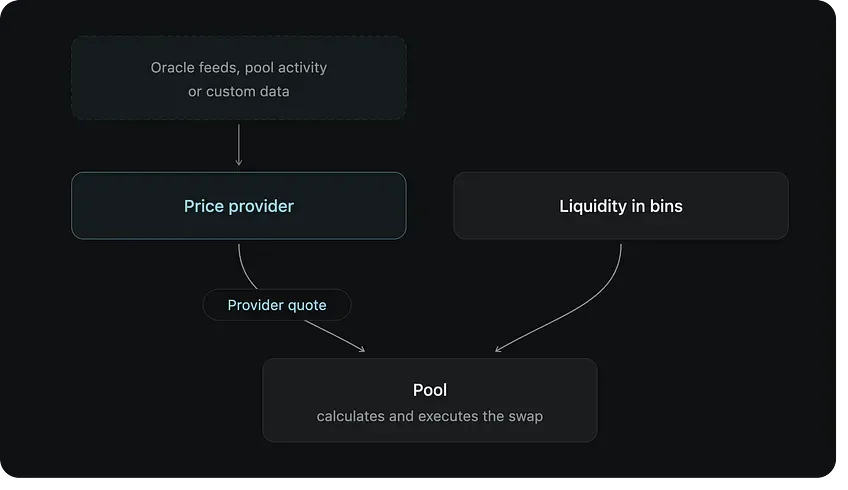
Metric splits a prop AMM into three roles:
Price providers supply the reference price: Chainlink, Pyth, Metric’s own feed, or a curator’s custom feed.
Curators set up the pool: the spread, the price provider and the safeguards. Think of Morpho’s vault curators, but for market making.
LPs fund the pool.
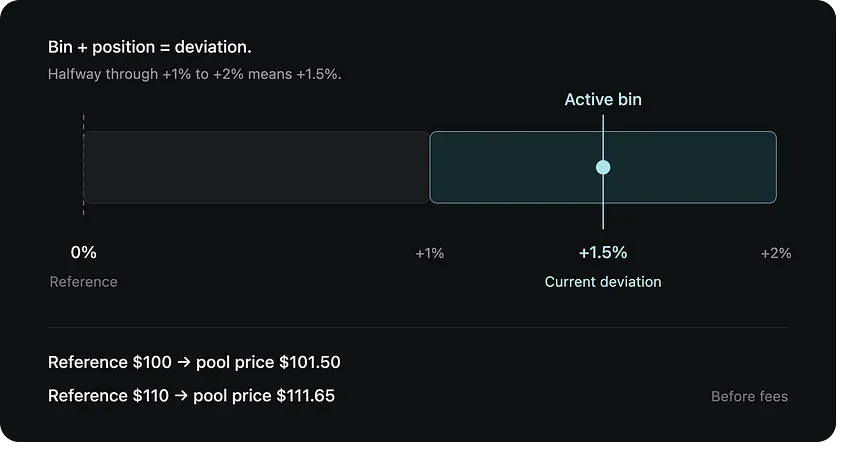
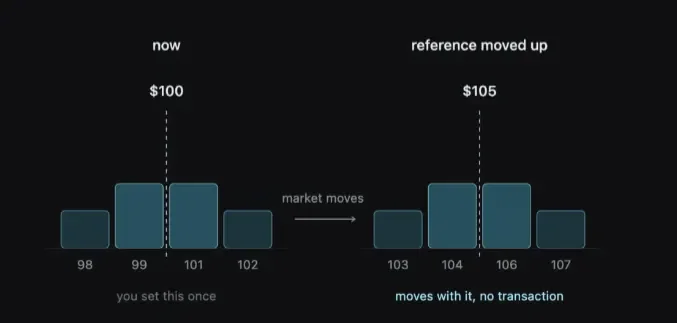
Bins that move by themselves. You deposit into bins, which are percentage ranges around the reference price. When the price moves, the bins move with it. A Uniswap v3 range is fixed in price and can go out of range; a Metric bin stays near the action.
LPs earn the spread, not a swap fee. Traders buy at the ask and sell at the bid, and LPs earn the gap around the reference price. Most large pools split it 80% to LPs, 5% to the curator and 15% to Metric. The Moebius-curated pools split it 85/0/15.
Public and private pools. Public pools take outside LPs. Private pools run on the curator’s own capital.
Does it work? In Castle Labs’ 11-day comparison of the WETH/USDC pool (Oct 15–26), measured one minute after each trade, Metric LPs made +0.44 bps per dollar traded, while Uniswap v3 LPs lost 1.01 bps. It’s one pair and nobody has reproduced it yet, but it’s the right sign.
Is It Safe?
Audits: five, by Zellic and Sherlock (May–Sep 2026), including a public Sherlock contest in July with up to $150K in rewards. The top payout was $11,936, which suggests no high-severity findings.
Bug bounty: up to $500K on Immunefi, live since Nov 10. Critical bugs pay $50K–$500K.
Code: pool, factory, swap-math, and oracle contracts are public on GitHub. The license is source-available (BUSL until 2029), not open source.
Open issues: Metric publishes a known-issues list, with October reports still pending fixes and November notes on stop-loss limits.
Team: mostly anonymous. The CTO is reportedly a former Director of Engineering at Uniswap, and the project is bootstrapped, with no outside funding (Castle Labs).
What Can Go Wrong
Inventory risk. The oracle stops you from being picked off at stale prices. It doesn’t stop you ending up holding the wrong asset. If ETH falls for a week, traders keep selling ETH into the pool, and a few bps of spread won’t cover the drop.
You’re trusting the feed and the curator. If the reference price is wrong or slow, you trade at the wrong price. A curator using a custom feed can widen spreads with no hard limit.
Fees can change without notice. Curator and protocol shares can change with no time lock, even on pools with locked pricing.
Safeguards have gaps. The per-bin stop-loss doesn’t protect the first swap into a newly funded bin, and it only checks bins the price crosses. It isn’t a cap on your total loss.
New code, anonymous team. The contracts have been live for about a month, with fixes pending.
