
Uniswap's Improved Pools Pay >10% — Here’s How it Works
TL;DR
A new Uniswap hook makes arbitrage bots bid for the right to fix a de-pegged stablecoin pair — and hands the winning bid to LPs instead of the bot.
Five days after launch, the USDC/USDT pool was reportedly the busiest on Ethereum, turning over its entire TVL almost seven times a day.
Two pools are live now — USDC/USDT and USDC/USDG — both paying 12–15% APR with zero token incentives, split among just $2–4M in TVL each.
The catch: that yield is high because almost nobody’s in yet. Once it’s noticed, the pie gets split thinner — and a real depeg still leaves you holding the bad asset, auction or not.
Stablecoin LPing has always had a strange reputation. It is the “safe” corner of DeFi — no impermanent loss to speak of, two dollars trading against two dollars — and yet almost nobody got rich doing it. Fees on stable pairs are razor thin, and the little price movement that does exist gets picked clean by arbitrage bots before LPs see any of it. You provide the liquidity, the bots take the profit.
On September 10, Uniswap Labs shipped its answer: the StablePair Hook, a Uniswap v4 hook that bolts an auction mechanism onto a regular AMM pool. The pitch is simple: when a stable pair drifts off its peg, whoever pushes it back has to bid for the privilege — and the winning bid goes to LPs.
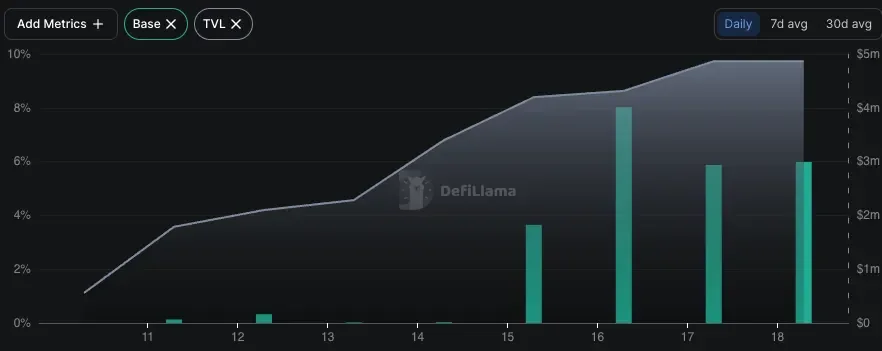
Five days after launch, the new USDC/USDT pool was reportedly the highest-volume pool on Ethereum. This piece goes through how the mechanism actually works, what it changes for anyone LPing stables, and what the two live pools look like as farms today.
How the yield is generated
A StablePair pool earns for its LPs in two distinct ways: a normal (tiny) spread when the pair trades near its peg, and an auction payment whenever the pair snaps back from a dislocation. The second one is the new part — it is arbitrage profit that used to leave the pool, now redirected to the people funding it.
Mechanically, each pool anchors on a reference price — for a dollar-stable pair, effectively 1:1 — and maintains a band around it, sized to the pair’s volatility and flow. Most LP liquidity sits inside that band, which is where virtually all stablecoin volume happens anyway. The hook then applies three different fee regimes depending on where the AMM price is:
Inside the band, the pool behaves like a normal v4 stable pool, except the fee recalibrates on every swap so that traders always see a fixed, predictable bid/ask spread around the reference price.
Price pushed out of the band, away from the peg: those swaps pay no fee at all. That sounds generous, but the seller is already handing the pool a good deal — they are selling into it at a growing discount to the reference price, so charging them a fee on top would just push the flow elsewhere.
Price coming back into the band: here is the catch. Swaps that correct the price from outside the band go through a Dutch auction. The fee starts high and drops every block until some arbitrageur decides the remaining profit is worth taking. The LPs keep whatever fee they accept
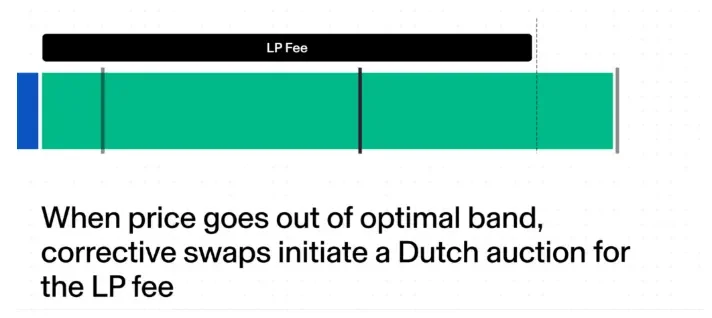
Play out a concrete round trip. Say a large seller dumps USDT and the pool’s USDT price slips below the band, to 0.998. The dumping swaps paid the pool nothing in fees, but they sold USDT to the pool at a discount.
Everyone knows the price will revert — USDT redeems at a dollar — so normally an arb bot would buy the cheap USDT and pocket the 20 bps. With the hook, that bot has to move through the auction: buy immediately and pay a fee that eats most of the 20 bps, or wait for the fee to decay and risk another bot stepping in first.
Competition between arbitrageurs pushes the trade toward “earliest block where it’s barely profitable” — which means most of the reversion profit ends up with the pool, not the bot. The LPs bought low on the way down and got paid on the way back up.
Two details worth knowing:
StablePair pools are created by Uniswap Labs, not permissionlessly — there are exactly two so far.
And it is Uniswap’s first upgradeable hook: pool parameters and fee logic can be tuned through Uniswap Governance without LPs having to migrate, a notable break from Uniswap’s immutable-contracts tradition, and something that cuts both ways (more on that below).
What it changes for stablecoin LPs
The problem this attacks is the quiet tax on every stable LP position. With a static fee, you are stuck between two bad options: set the fee low and arb bots snipe every tiny dislocation for free, or set it high and traders route around you.
Either way, the value created when a peg wobbles and reverts — real, recurring value on pairs that do $43.4 billion a quarter on Uniswap alone — flowed to whoever ran the fastest bot. Uniswap’s simulations, cited at launch, put LP returns under the dynamic-fee design roughly 1.9% higher than flat-fee equivalents.
On positions that historically earned low single digits, that is not a rounding error — it is the difference between stable LPing being dead money and being competitive with lending.
For the LP experience itself, three things change:
You do less work. The band does the thinking. You concentrate liquidity around the peg like you would in any stable pool, but you are no longer punished for not micromanaging the position when the pair dislocates — the auction claws value back for you while you sleep.
Depegs sting less. You still absorb the weaker asset on the way down (nothing changes that — it is the nature of LPing), but instead of arb bots capturing the entire recovery, the auction routes a large share of the round-trip profit back to you. Peg volatility shifts from being purely a cost to being partly a revenue source.
Your yield is flow-dependent and honest. There are no token incentives on these pools right now. The APR is swap fees plus auction proceeds, so it scales with volume and with how often the pair wobbles — and it will compress as TVL grows.
The bigger change is behavioral. In an ordinary concentrated stable pool, the moment price leaves your range you face a bad choice: rebalance and realize the loss — selling the weaker asset near the bottom, which is how stable LPs quietly bleed on every wobble — or sit in a position earning nothing, with no assurance the price comes back to you. StablePair tilts that decision firmly toward sitting still.
There is no reason to place liquidity outside the band in the first place, since outbound swaps through it pay zero fee, and the auction actively pays arbitrageurs to bring the price back to where your liquidity is waiting. Waiting becomes the rational default: you stop chasing the price and let the price come back to meet you.
That does not repeal impermanent loss — a true depeg still leaves band-concentrated LPs holding the bad asset — but it removes the realized losses of rebalancing into every transient dislocation, which for stable pairs is where much of the historical bleed came from.
The same geometry disciplines traders. With virtually all liquidity packed inside the band, execution outside it deteriorates fast — the zero fee on outbound swaps is real, but price impact ramps just as quickly, so what the fee waiver gives, slippage takes back.
The practical effect is that flow either stays inside the band, trading at a tight and predictable spread, or dislocates the pool briefly and gets pulled back through the auction, with LPs pocketing the difference either way.
If this works as designed, it is a flywheel: better LP economics draw more capital into the band, deeper in-band liquidity means lower price impact than competing venues, lower price impact attracts more flow, and more flow pays LPs more.
The first week’s turnover numbers are consistent with that story — but the reflexive part is exactly the part that needs a few more weeks of data, once launch attention fades, before it can be called proven.
This is exactly the kind of dynamic-fee mechanism we track every week in Farming — if you want the running list of stablecoin farms ranked by risk-adjusted yield, that’s where we keep it updated.
The farming opportunity today
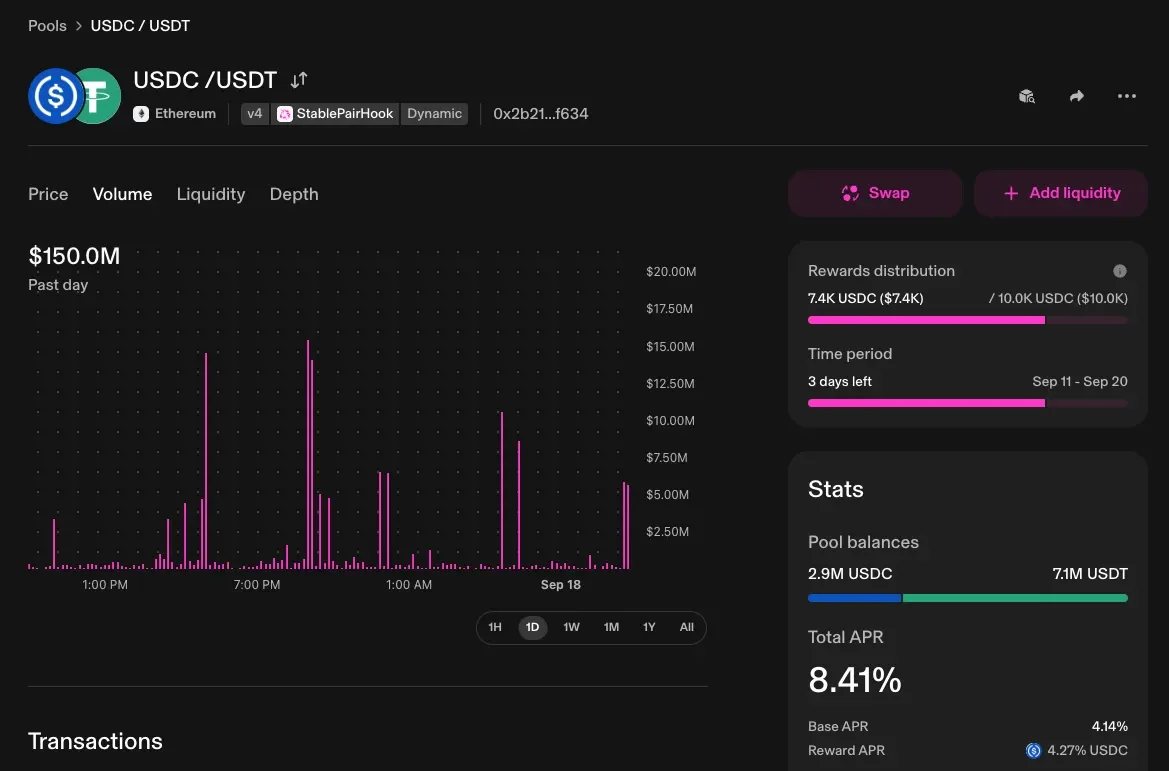
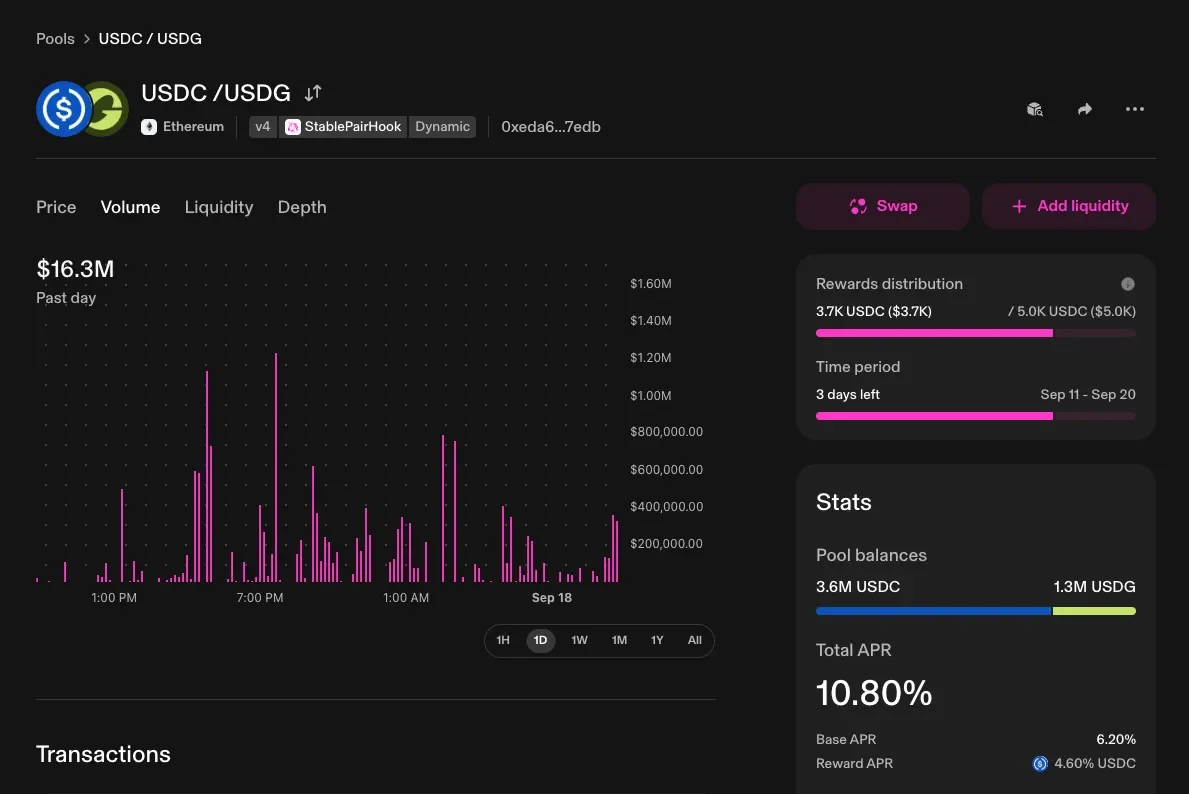
Two pools are live, both on Ethereum mainnet: USDC/USDT and USDC/USDG:
What jumps out is the turnover. A normal stable pool turning over its entire TVL seven times a day would be extraordinary; here it is the design working as intended — tight, predictable spreads attract aggregator flow, and the pools are still small. Even at fractions of a basis point per swap, that kind of churn annualizes into double-digit fee APR on today’s TVL.
The USDC/USDG pool was showing around 12% APR in mid-September; the USDC/USDT pool turns over nearly twice as fast per dollar of TVL. For an unincentivized, blue-chip stable pair on mainnet, that is a rare setup — comparable stable LPs on Curve or in lending markets have mostly paid low-to-mid single digits this year.
The early-mover logic is straightforward: yield here is a fixed-ish pie (volume × captured spread) divided by TVL. At $2–4M TVL against $13–16M daily volume, the pie is being split among very few LPs. That will not last — if the APR holds, TVL will come. The window is being in before it does. These numbers are one week old, the launch buzz is inflating volume, and the sustainable run-rate is unknown.
Execution is plain Uniswap: open the pool page, add liquidity as a v4 position concentrated around the peg (the app’s default range for these pools is sensible), and you are earning from the next swap. Mainnet gas is the main friction — at typical position sizes under ~$10k, entry/exit costs eat a meaningful slice of the first months’ yield, so this farm suits five-figure-plus positions held for a while, not hot money.
Risks
Position-type risk (LP).
This is an LP position in a stable pair, and it behaves like one. If either asset truly depegs — not a 20 bps wobble but a real break — the pool converts your deposit into the failing asset as everyone sells it into your liquidity, and no fee mechanism compensates for holding a coin that does not come back. The auction improves your economics on mean-reverting moves; it is not insurance against a one-way move.
Beyond that, the hook itself is new: it is an additional smart contract layered on v4, live for one week, with a novel mechanism that sophisticated MEV actors are only starting to probe.
And because parameters are upgradeable through governance, what you signed up for can change — mostly a feature (fixes without migration), but also a trust assumption that immutable pools did not have.
Finally, expect APR volatility: quiet weeks with no peg wobbles and thinner volume will pay materially less than the launch-week snapshot.
Underlying asset risk.
Your real exposure is the basket. USDC is the de facto anchor of both pools and the least controversial leg.
USDT is the world’s largest stablecoin and its peg has been resilient for years, but it remains the leg with the least reserve transparency — attestations rather than full audits, and a long-running discount/premium cycle around risk events; in a USDT stress scenario, the USDC/USDT pool is precisely where sellers will unload it.
USDG (Global Dollar) is the newer name: issued by Paxos out of Singapore under MAS’s Major Payment Institution framework (and via a MiCA-authorized entity in the EU), roughly $3.2B in circulation, reserves held in money-market funds, T-bills and bank deposits at custodians including DBS and Standard Chartered, with quarterly KPMG attestations.
On paper it is one of the better-regulated stables; the trade-off is a shorter track record and shallower secondary liquidity than USDT — its band should be quieter, but a dislocation could take longer to arb back (which, ironically, is when the auction pays you most).
Our take
The StablePair Hook is the most interesting thing to happen to stablecoin LPing in a long time, because it fixes the actual problem — not “stable pools don’t earn enough fees” but “stable pools leak their most valuable flow to bots.”
Auctioning off the right to re-peg the pool is a clean way to have arbitrageurs compete against each other rather than against LPs, and the first week’s numbers suggest the flow is real. It is also a shot across Curve’s bow: Uniswap is coming for the stable-swap franchise with better LP economics as the weapon.
What to do right now
If you have $10k+ in idle stables: consider a concentrated v4 position in USDC/USDT or USDC/USDG — use the app’s default range, and expect entry/exit gas to eat into the first month’s yield.
If you’re under $10k: wait. Gas costs will outrun the yield edge at small sizes; watch TVL and APR for a few more weeks instead.
Either way: treat the 12–15% launch-week APR as a ceiling, not a baseline — it will compress as TVL scales.
Watch for: whether Uniswap Labs extends the hook to more pairs and chains, which the upgradeable design suggests is the plan.
