
CLARITY Act Heads to Senate Floor as Crypto's Defining Bill Nears Final Test
The CLARITY Act is headed for a full Senate floor vote — the last real obstacle before the United States finally has a statutory answer to the question that has governed crypto for a decade: who decides whether your token is a security, and when?
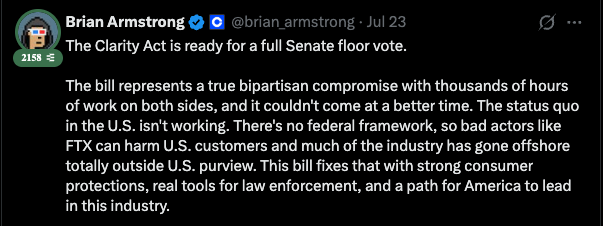
The CLARITY Act is a rulebook that assigns every crypto token to one of two U.S. regulators — and, for the first time, gives a measurable test for deciding which one.
Today there is no such test. Whether your token counts as a security is settled after the fact, in court. Without a statutory answer, the question gets resolved by whichever agency sues first, or whichever party holds the White House. Registration, custody, listing decisions and disclosure obligations all hang off that one unanswered question
CLARITY answers it with a checklist. A token whose value is intrinsically linked to its blockchain becomes a "digital commodity" — regulated by the CFTC, not the SEC — and stablecoins, securities and derivatives are excluded from the category.
The qualifying condition is that the network behind it is genuinely decentralized: a "mature blockchain" is one not controlled by any person or group under common control, which in practice means no single entity holding more than 20% of supply or voting power, full operational functionality, and no founder or company able to unilaterally upgrade the network.
Pass the test, you are a commodity. Fail it, you stay under the SEC until you pass. Projects get up to four years to reach maturity, in exchange for disclosing source code, governance, token functionality and use of proceeds.
What the impact is
Launching a token stops being a gamble. Today a token sold once in a private round can stay legally radioactive forever. CLARITY separates the asset from the fundraise — an "investment contract" no longer includes the asset itself — narrowing the "security forever" interpretation that has haunted builders. A U.S. team can plan a launch against criteria instead of moving offshore to avoid them.
Exchanges get a federal license that doesn't currently exist. The bill creates CFTC registration categories for brokers, dealers, trading facilities and custodians, with standards for custody, disclosure, market conduct and operational resilience, plus a provisional pathway for firms already operating.
Your money on a centralized exchange gets legal protection. The bill imposes requirements on trade monitoring, recordkeeping and the commingling of customer assets, and puts digital commodity exchanges, brokers and dealers under the Bank Secrecy Act for anti-money-laundering purposes. This is the FTX lesson converted into statute.
Writing code stops being a legal risk. Non-controlling developers and infrastructure providers are exempted from being treated as money transmitters simply for building — ending the theory used to prosecute people who never touched a user's funds.
And it becomes permanent. This is the part markets care about most. Existing SEC and CFTC guidance can be rescinded overnight by any future administration without a congressional vote. Only a statute survives a change of administration. Institutional capital does not commit to rules that expire with an election.
The current Status:
Trump has agreed to crypto restrictions covering government officials including himself, clearing the Republican side. Backers still need at least seven Democratic votes to break a filibuster and only two have signed on. Lummis has warned that missing this window could push market structure legislation to 2030 — or kill it outright.
