
Earn Yield on Tokenized Stocks: 3 Ways to Farm TSLA, NVDA, and more...
So you’re tired of token rugpulls and want to hold a real business. Welcome to the club. Tokenized stocks went from about $28.6M in active assets in June 2025 to $2.85B today, roughly 100x in 16 months (DefiLlama).
Here’s the interesting part: only $353M of that, about 12%, is actually deposited in DeFi. The other ~88% sits in wallets and exchange accounts doing nothing. That’s the opportunity.
One honest caveat before we start: you mostly don’t own the business. Coinbase’s tokens are SPV certificates, with the real shares held at a broker. Robinhood says its Stock Tokens give no legal or beneficial rights in the underlying stock. You’re trading token rug risk for issuer risk. That’s a fine trade for farming, as long as you know you’re making it.
So why hold stocks onchain at all? Access matters if you’re outside the US, and 24/7 trading is nice. But the real reason is composability: onchain, a stock can be collateral, LP inventory or vault capital. That means yield. Here are three ways to farm it, and one I’d skip.
Where the action is
Two chains matter right now.
Base. Coinbase issues tokenized stocks under its own B20 standard. Tickers carry a “c” suffix: NVDAc, METAc, GOOGLc. Aerodrome is the main DEX, and Aave V4 accepts seven of them as collateral.
Robinhood Chain. Robinhood’s own L2, live since July 1, with 1:1-backed Stock Tokens. Uniswap holds nearly all stock liquidity. The chain sits at about $1.15B TVL with $331M in tokenized assets.
Solana has xStocks, with Kamino as the main lending market, but most new farming activity is on the two chains above.
Tip: liquidity is concentrated in a handful of megacaps. Coinbase issues 173 stocks on Base, but only about a dozen have pools deep enough to trade at size. Start there.
Access note: nearly all of these products are for non-US users only. US readers can look at Dinari, which opened tokenized stocks to eligible US investors in August.
Strategy 1: The carry trade
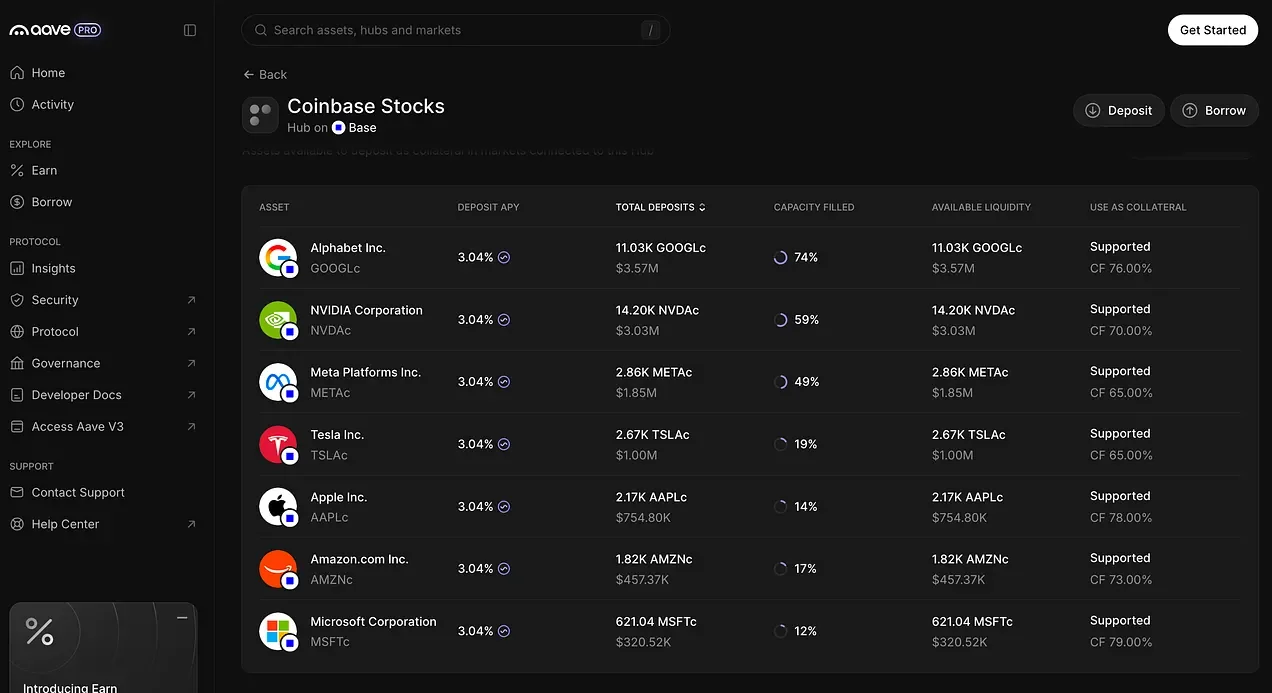
How it works: deposit your stock as collateral, borrow USDC against it, and put that USDC into a stablecoin yield. You keep full exposure to the stock and earn the spread between what the USDC earns and what you pay to borrow it.
Aave V4 Coinbase Stocks Hub
On top of that, deposits on the Aave V4 Coinbase Stocks Hub also earn about 3% in rewards, which adds to your return and widens the spread. On Base, Aave V4 is the venue; on Solana, Kamino.
Who pays you: stablecoin borrowers elsewhere in DeFi, minus your own borrow cost.
What to check:
The spread. Check your borrow APR against what you’re earning on your USD farm and make sure you have a good buffer.
Your loan-to-value. You’re borrowing against a volatile asset. A 20% drawdown on a stock is a normal bad month.
Oracle hours. Aave prices these stocks with Chainlink feeds, not DEX prices. The feeds pause from Friday 8pm to Sunday 8pm ET. The token keeps trading on DEXs all weekend, but Aave holds Friday’s price, then reprices everything at once when the feed restarts.
Tips:
Borrow well below the max. Leave room for an earnings gap plus a weekend.
Be careful — consider cutting your loan before earnings on the names you hold.
Use a vault that rebalances for you if you won’t watch the position. Several now package this trade with extra rewards on top (see the paid section for the ones I’d look at).
Strategy 2: LP your stocks
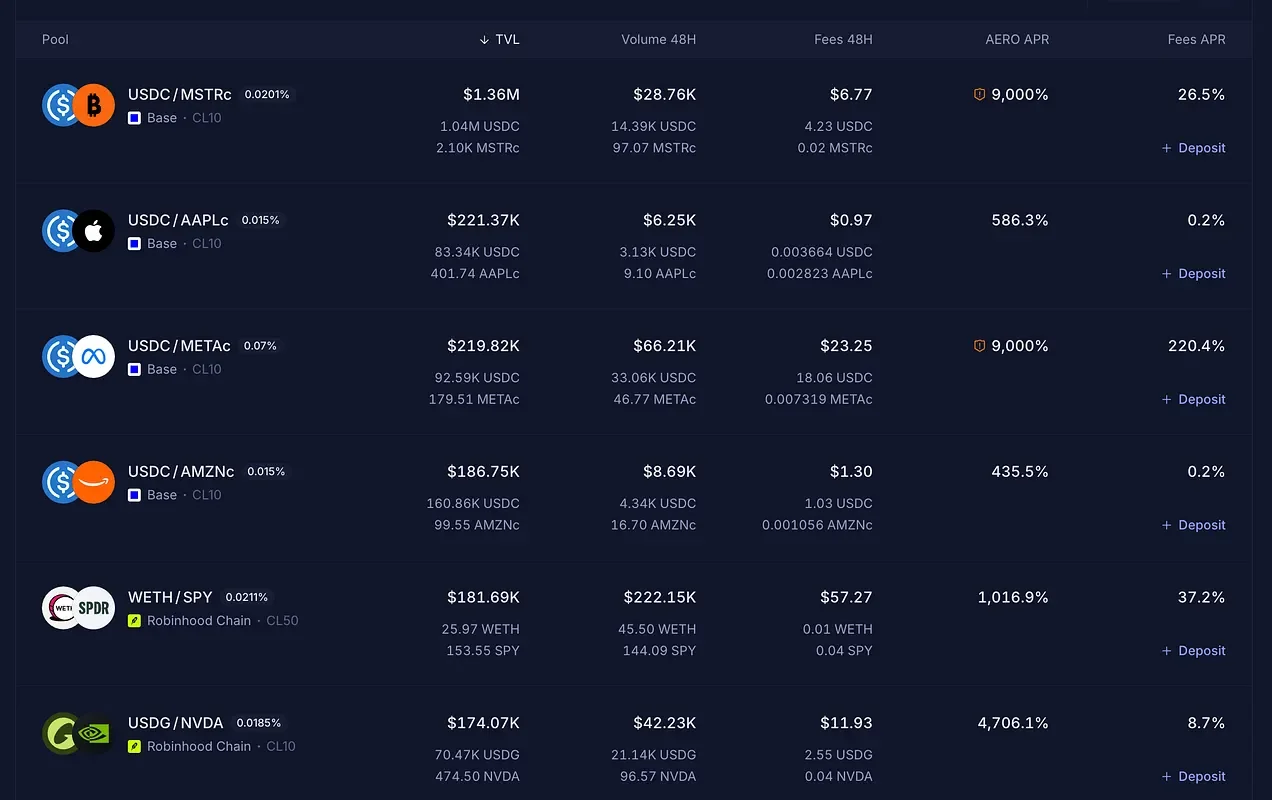
How it works: pair a stock with a stablecoin in a concentrated liquidity pool and earn from traders swapping through your range. You’re market making a stock, something that used to be a closed club.
Who pays you: traders. On Robinhood Chain (Uniswap), that’s swap fees. On Aerodrome it’s mostly AERO emissions, because staked LPs give up swap fees to sAERO voters.
APY fluctuates: the APY column “lies”. One vault dashboard currently shows a METAc–USDC vault on Base at 83 quadrillion percent. That’s one day’s rate compounded over a year on a tiny base. Check the APR or volume/TVL over several days to get more accurate numbers.
Tips:
Only LP stocks you’d own anyway. A concentrated range buys as the price falls and sells as it rises. If a stock dumps, you end up holding more of it. Make sure you want more of that stock.
Filter by liquidity before yield. Before you enter, check what it would cost to swap your full position size on exit. If it’s more than a few weeks of fees, the pool is too thin for you.
Stick to high-volume names. NVDA, META, GOOGL and TSLA have the deepest pools. A thin pool with a big APY is usually a trap.
Read daily rate, volume and pool TVL, not APY. Fees earned per day relative to pool size is the honest number.
Watch the gaps. Weekend trading onchain tracks Monday’s open fairly well. Earnings gaps are what hurt LPs.
Automate it. Managed vaults rebalance your range around the clock, including weekends while you sleep.
One way to think about it: a concentrated LP is a lot like selling options. You’re paid for taking on volatility, and you end up holding more of the stock if price runs through your range. That brings us to strategy 3.
Strategy 3: Options vaults
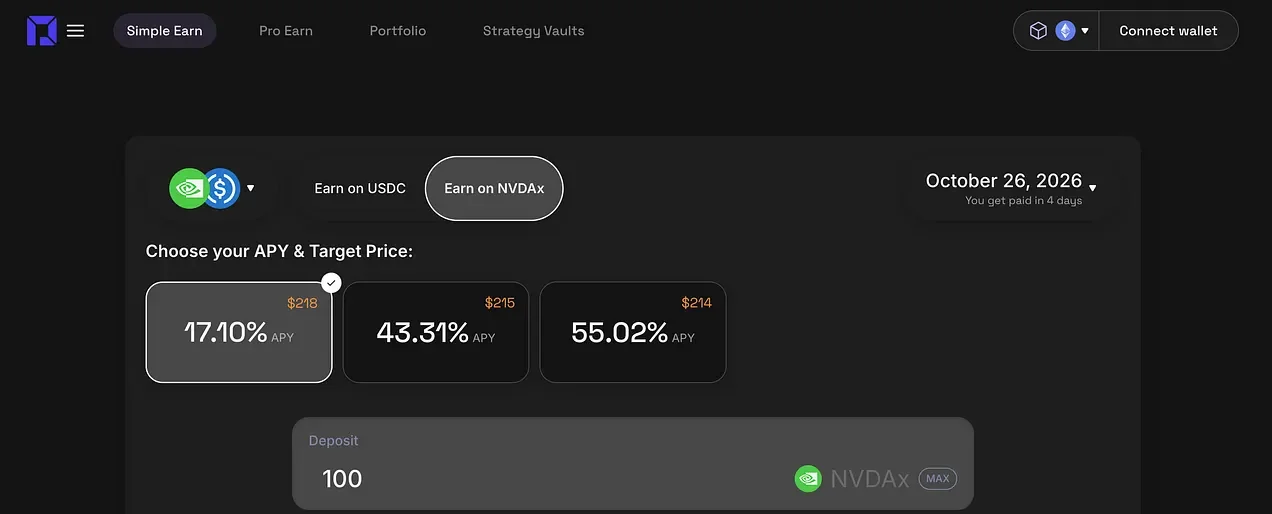
How it works: pick a price you’d happily sell at (above today’s) or buy at (below today’s). You earn a fixed yield while you wait. If the price hits your target at expiry, the trade executes at your price. If not, you keep your original asset plus the yield. In TradFi terms, these are covered calls and cash-secured puts.
Who pays you: option buyers. Of the four strategies, this one has the clearest answer.
Where: Prodigy.Fi launched tokenized stock vaults on October 1, starting with NVDAx on Ethereum, with more tickers planned.
A real example: with NVDAx at $241, Prodigy’s sell-high vaults on the same expiry paid:
For both buy and sell vaults, closer to the current price means higher yield and a better chance you'll actually trade into, or out of the asset. That’s the risk - but also the source of yield.
Tips:
Pick a price you genuinely want. Only sell at a price you’d be happy to take profit at, and only buy at a price you’d be happy to own the stock at.
Check the expiry. Prodigy’s stock vaults expire on weekdays, while the real market is open. That avoids settling on a stale weekend price.
Compare it to LPing. An LP pays variable fees and rebalances constantly, with slippage every time. An options vault pays a fixed rate at one price you chose, settled once.
Disclosure: I’m an advisor for Prodigy.fi
The one I’d skip: delta-neutral funding
Hold the stock, short the same amount on a perp like Hyperliquid’s HIP-3 equity markets, and collect funding. It looks like free money. Perps are where the speculation is: RWA perp open interest is about $18.3B, roughly 6x the tokenized stock spot market, and longs often pay big rates to stay in.
Here’s the catch. The perp trades 24/7, but after hours and on weekends liquidity is thin and there’s no real stock price anchoring it. A weekend pump on a thin book can liquidate your short, and your spot leg can’t save you: moving collateral between venues takes time, and selling spot into a thin weekend pool costs you. Funding swings hard too. In July, the Seoul-listed SK Hynix perp ran a +37% monthly median funding rate while the ADR version ran −4%.
Those juicy rates are partly alpha, but a lot of it is risk premium. You’re getting paid to take a risk most people don’t want. Unless you run it professionally, with heavy margin and someone watching on weekends, this strategy is much riskier than it looks.
Before you farm: a checklist
Know what you hold. Check whether your token is a certificate, a derivative or a real share, and whether you can redeem it (usually only with KYC).
Know the oracle hours. Lending oracles pause from Friday 8pm to Sunday 8pm ET while DEXs keep trading. Your DEX price, oracle price and perp price can all disagree over a weekend.
Check exit liquidity first. Size your position to the pool, not to the APY.
Check access. Most of these products block US users.
Count the layers. Issuer, chain, DEX, lender, vault: each one is another thing that can break. A 14% yield across five protocols is not the same as 14% on one.
Watch corporate actions. Lenders like Aave pause a stock’s market during splits until the token is adjusted.
The yield is real, but the tokenized stock market is early. Pools are thin, and the most interesting opportunities are small. That’s exactly when it pays to be early, and to be careful.
