
Tokenized Stocks on-chain: where the real innovation (and alpha) actually is
TL;DR
Tokenized stocks aren’t just a narrative — they’re becoming usable on-chain collateral, and the smartest DeFi users are already treating them as productive capital rather than passive exposure.
The real opportunity isn’t trading tokenized equities, but what you can do with them once they sit inside DeFi — especially in slow or sideways crypto markets.
As equities begin integrating on-chain, DeFi portfolios may shift from crypto-only to fully multi-asset — opening strategies that previously only existed in hedge funds and TradFi.
This keeps you fully on-chain while your core capital remains tied to large-cap equity performance.
Tokenized stocks aren’t just a narrative — they’re becoming usable on-chain collateral, and the smartest DeFi users are already treating them as productive capital rather than passive exposure.
The real opportunity isn’t trading tokenized equities, but what you can do with them once they sit inside DeFi — especially in slow or sideways crypto markets.
As equities begin integrating on-chain, DeFi portfolios may shift from crypto-only to fully multi-asset — opening strategies that previously only existed in hedge funds and TradFi.
U.S. equities are a ~$69T market, while the entire crypto market is valued at around 2.3T. We can’t deny that U.S. equities are 20x larger than crypto is right now.
But despite its size, the system behind it is slow, layered, and heavily intermediated. Even today, most equity trades still move through brokers, clearinghouses, and centralized settlement infrastructure built decades ago.
That structure exists for one main reason: counterparty risk.
Understanding this is key to understanding tokenized stocks — and why putting equities on-chain is much harder than most people think.
And more importantly for us: where the actual alpha for DeFi users is.
Model 1: Perpetual futures (synthetic exposure)
Perp exchanges were the first place equities effectively went “on-chain.”
Perpetual futures allow: – 24/7 trading – leverage – long/short exposure – no expiry
But they are purely synthetic.
They don’t provide: – dividends – ownership – legal rights – claim on underlying shares
They track price using funding rates and market mechanisms.
This makes them easy to launch and highly liquid, but they are trading instruments, not real equity exposure.
For DeFi traders, perps are useful for speculation — not portfolio diversification.
Model 2: Wrapped/tokenized equities (what we mostly have today)
This is the current dominant model.
Platforms like Ondo Global Markets and XStocks tokenize equities they control through custodians, SPVs, or broker relationships.
Users receive: – price exposure – dividend-effect exposure – 24/7 trading – potential DeFi composability
But they typically do not receive: – direct ownership – voting rights – enforceable legal claims on shares
In many cases, a broker like Alpaca sits in the middle holding the real equities.
So compared to traditional markets: Tokenization often adds an extra layer rather than removing one.
This introduces counterparty and legal risk — but also introduces something powerful:
on-chain composability.
Core strategy: using tokenized indexes as productive collateral
Tokenized stock indexes can function as a new type of on-chain collateral that combines long-term equity exposure with flexible DeFi capital deployment.
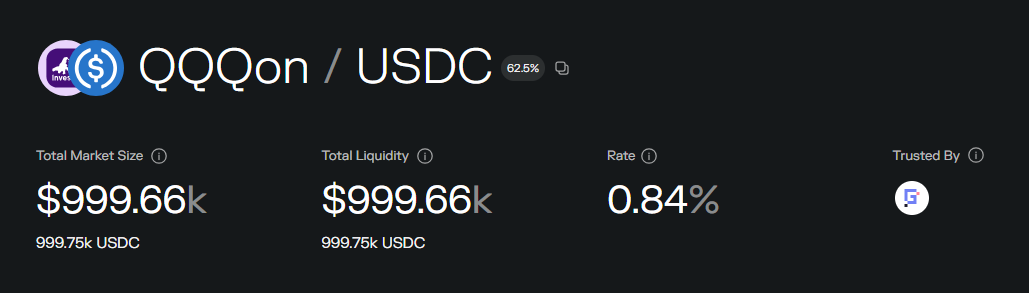
Instead of holding only stables or ETH as collateral, you can hold SPYon or QQQon, maintain exposure to real-world earnings growth, and borrow against that position to generate additional yield or incentives on-chain.
The base structure is simple:
Hold tokenized index exposure
Borrow conservatively against it (typically 40–50% LTV),
and redeploy the borrowed capital into yield strategies, incentive farming, or market-neutral trades.
This keeps you fully on-chain while your core capital remains tied to large-cap equity performance.
Here are some ideas on how you can utilize this integration:
1. A conservative approach focuses on stable yield: Holding $100k in SPYon or QQQon and borrowing $40k–$50k in stables, then deploying those stables into lending markets, delta-neutral vaults, Pendle fixed yield, or RWA strategies.
If stable yields average around 10%, that borrowed capital can generate roughly $5k per year while you still maintain full equity exposure.
2. A more incentive-driven approach uses the same structure but deploys borrowed capital into airdrop and points farming.
This can include delta-neutral perp DEX strategies, new lending protocols, incentive-heavy stable pools, or restaking and stable-based campaigns.
The goal here is to accumulate points and incentives while maintaining equity exposure, which can be especially effective during sideways crypto markets where token prices stagnate but reward programs remain active.
3. For advanced users, the structure can evolve into a market-neutral carry trade.
After holding tokenized equity exposure and borrowing stables, the borrowed capital can be deployed into delta-neutral perp strategies—such as going long on spot while shorting the perp to collect funding and incentives.
This creates a portfolio that combines equity exposure with a market-neutral yield engine, similar to how multi-asset funds operate in traditional finance, but executed entirely on-chain.
Tokenized equities are still early. But the direction is clear: all major assets are moving on-chain in some form.
For DeFi users, the opportunity isn’t replacing crypto with stocks.
It’s expanding the opportunity set.
In strong crypto bull markets, tokenized equities won’t matter much. In slow or uncertain crypto markets, they become a powerful rotation tool.
The future DeFi portfolio won’t be crypto-only.
It will be multi-asset, fully on-chain, and able to move capital anywhere instantly.
Tokenized stocks are one of the first steps toward that world.
Follow
for more content like this
