
Prediction Markets: How They Work and How to Actually Make Money
Billions of dollars now trade on the outcomes of elections, price movements, and world events — all on-chain. Here's everything you need to know to get started and find your edge.
In this guide
Introduction - What it is, how do they work
Best platforms in 2026
How to get started (step-by-step)
Strategies to make money
The arbitrage playbook
Risks you need to know
What Are Prediction Markets?
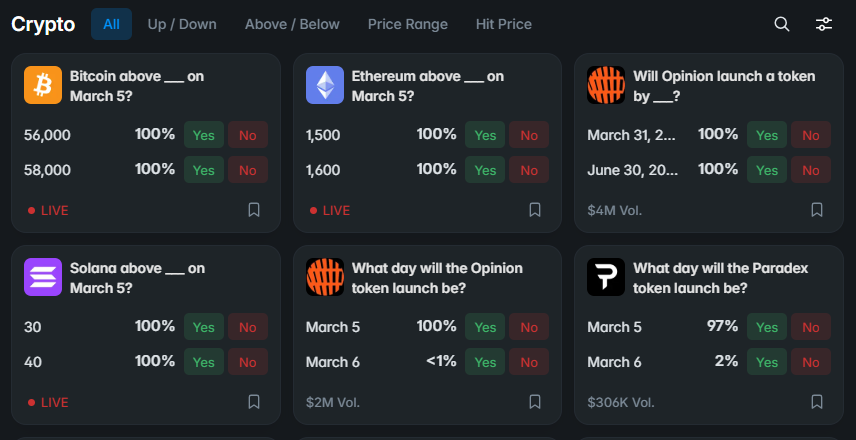
Here's the simplest way to think about it: prediction markets let you put money on whether something will happen. Will Bitcoin hit $150K before the end of the year? Will the Fed cut rates in Q3? Who wins the next election?
But unlike traditional betting, the price of each contract tells you something genuinely useful — it reflects the collective probability that the crowd assigns to that event. A contract trading at $0.72 means the market thinks there's roughly a 72% chance of it happening. That's the wisdom of crowds, priced in real time.
In crypto, these markets run on blockchains, which means they're globally accessible, transparent, and often settle in stablecoins like USDC. By 2026, the sector has grown into a multi-billion dollar industry, with platforms like Polymarket and Kalshi processing over $10 billion in monthly volume and integrations with exchanges like Coinbase and Robinhood bringing prediction markets to mainstream retail traders.
How Prediction Markets Actually Work
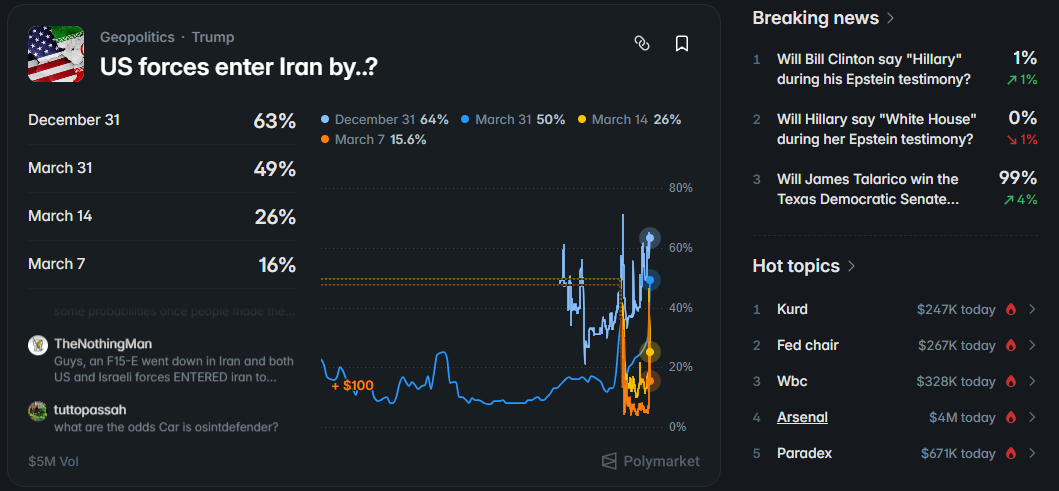
Every market follows the same basic structure, regardless of the platform.
The mechanics, simply:
A market is created around a specific, verifiable question — something like "Will ETH trade above $5,000 on June 30, 2026?" Users can buy YES shares or NO shares. Each share is priced between $0 and $1, depending on how likely the market thinks the outcome is.
When the event resolves, winning shares pay out exactly $1. Losing shares go to zero. Simple. But the interesting part happens in between — because you can buy and sell your shares before resolution, just like a stock.
1) A market opens - An event with a clear resolution criterion is listed — e.g., "Will BTC exceed $120K by Dec 31, 2026?" Initial odds are set by the platform or early traders.
2) You take a position - Buy YES or NO shares at the current price. The price moves based on supply and demand as more traders take sides.
3) The market moves - As news, data, and sentiment shift, prices change. You can sell your position at any time and lock in profits — or cut losses — before the event resolves.
4) Resolution - An oracle — either a decentralized protocol like UMA (used by Polymarket) or a trusted data source — determines the outcome. Winning shares pay $1. Losers pay $0.
Liquidity is provided either through automated market makers (AMMs), order books, or a hybrid. Platforms charge small fees on trades or at resolution, typically 1–2%.
The Best Prediction Market Platforms right now:
-
The largest decentralized prediction market. Covers politics, crypto prices, macro events, and sports.
Uses an order book model. Best for liquid, high-profile markets. No token yet — but Polymarket's CMO confirmed in late 2025 that a token is planned, with the timeline expected to follow the U.S. market relaunch.
Strong expectation of a $POLY airdrop in 2026, and the market widely believes genuine, consistent trading activity will be the primary qualifier.
-
The leading regulated prediction market. Accepts both fiat and crypto. U.S.-focused but expanding globally.
Best for compliance-conscious traders and macro event betting.
No airdrop expected — Kalshi operates as a traditional regulated exchange, not a token-based protocol.
-
Solana-native, high-speed. Integrates with Drift's perpetuals exchange.
Unique advantage: you can earn yield on your collateral through Drift's borrow/lend engine while your bets are active — your capital isn't sitting idle.
Already has the DRIFT token with governance and staking. Drift ran a FUEL rewards program (Season 2) that drove its first airdrop.
Future DRIFT distributions will depend on governance, but active BET users are well-positioned if another round happens.
-
The OG decentralized prediction market. Lets anyone create markets. Best for niche or custom events. Resolution handled by REP token holders.
Already has a token — no new airdrop expected.
-
BNB-native prediction market backed by YZi Labs and founded by the former Head of Research at Binance (also the creator of PancakeSwap). Has received public attention from CZ.
Predict.fun launched its official Points Farming Campaign in December 2025. Points are earned through trading volume, prediction accuracy, and referrals. They also use a yield-bearing architecture — your staked funds earn passive interest on Venus while backing your bets.
This is one of the strongest active airdrop farms in prediction markets right now.
If you've traded on Polymarket, Limitless, or Opinion Labs before, you may already have reserved points waiting to be claimed.
-
Combines opinion polling with on-chain prediction mechanics.
Lets users bet on sentiment-driven outcomes — a unique angle for traders who follow social narratives and community signals.
Runs an OPN Points campaign that incentivizes prediction activity and trading participation.
-
n emerging BNB Chain prediction market focused on accessible, low-barrier markets.
Worth watching as the BNB prediction market ecosystem continues to grow in 2026.
Beginner Recommendation:
Start with Polymarket. It has the most liquidity, the most active markets, and the most public attention — which means better pricing and easier entry and exit. Connect MetaMask, bridge some USDC to Polygon, and you're live in under 10 minutes.
How to Get Started: Step-by-Step
Getting into crypto prediction markets is easier than most DeFi products. Here's how to go from zero to your first position on Polymarket, the most beginner-friendly option.
1) Set up a wallet
Install MetaMask (browser extension or mobile). Create a new wallet and save your seed phrase somewhere safe. This is non-negotiable — losing your seed phrase means losing your funds permanently.
2) Buy USDC
Purchase USDC on any major exchange — Coinbase, Binance, Kraken. This is your trading currency on most platforms. Start small: $50–$100 is more than enough to learn the mechanics.
3) Bridge to Polygon
Polymarket runs on Polygon for low fees. Use the Polygon Bridge or directly purchase USDC on Polygon via Coinbase. Gas fees on Polygon are typically fractions of a cent.
4) Connect to Polymarket
Go to Polymarket.com, click "Connect Wallet," and approve the connection in MetaMask. You'll see your USDC balance appear in the interface immediately.
5) Find a market and take a position
Browse markets, check the liquidity and volume (avoid thin markets — wide spreads hurt you), and place a small YES or NO order. Watch how the price moves as news develops. Exit whenever you want.
Strategies to Make Money
In every market, you need an edge. You're trading against other people — some of them professionals, some running bots. Dumb money gets slowly bled by the market. Here's how to build an actual edge.
The information edge strategy
This is the most sustainable approach long-term. Find events where you genuinely know more than the average market participant. If you work in macro finance and see a Fed decision mispriced, that's your edge. If you're deep in a crypto community and see sentiment diverging from Polymarket odds, trade it.
The key is to stick to your domain. Don't bet on cricket if you don't follow cricket. Prediction markets punish generalists who spread thin.
The volatility strategy
Markets overprice certainty when nothing is happening, and they misprice uncertainty when everyone is panicking. Buy YES on events that look more likely than their price implies during periods of fear and confusion. Sell into clarity. As one trader put it: panic creates free money through mispricings — your job is to be calm when everyone else isn't.
The Arbitrage Playbook
Arbitrage is the closest thing to a free lunch in these markets — and it's the best starting point for beginners. There are three main types worth knowing.
1. Intra-market arbitrage
On most platforms, YES shares + NO shares should always sum to approximately $1. If you find a market where YES trades at $0.45 and NO at $0.48, the total is $0.93 — buy both and pocket $0.07 per share at resolution. If they sum to more than $1, short both.
Reality check: bots dominate this strategy at speed. You'll rarely catch these manually. But spikes happen during high-volatility events when automated systems lag — keep an eye out.
2. Cross-platform arbitrage
The same event can trade at different prices on Polymarket versus Kalshi. If YES on "BTC above $100K by Q4" is at $0.60 on Polymarket and $0.52 on Kalshi, you buy on Kalshi and sell (or take the opposite position) on Polymarket. The gap closes as the market corrects — you profit on the convergence. Windows typically yield 1–15% but close fast.
3. Combinatorial arbitrage
On multi-outcome markets (like election candidates), all the outcome probabilities should sum to 1. If they don't, there's a trade. For example, if Candidate A (45¢), B (35¢), and C (25¢) sum to $1.05, the market is overpriced — short the field.
Risks You Need to Know
Prediction markets are compelling — but they come with real risks that aren't always obvious to newcomers.
Oracle risk: The entire payout mechanism depends on correct resolution. If the oracle fails, gets manipulated, or the resolution criteria is ambiguous, you can lose money on a bet that should have won. Always check how a market resolves before taking a position.
Liquidity risk: Low-volume markets have wide spreads. Entering a thin market at $0.60 might mean you can only exit at $0.50 even if your view is right. Stick to markets with meaningful daily volume — at least $50K–$100K — until you understand the dynamics.
Smart contract risk: On-chain platforms carry smart contract risk. A bug or exploit could drain funds. Stick to audited, established platforms. Don't put in more than you're comfortable losing entirely.
Regulatory risk: The legal landscape for prediction markets is still evolving. Kalshi is CFTC-regulated; most crypto-native platforms operate in a gray area depending on your jurisdiction. Know the rules where you live.
Risk management basics
Start by limiting any single position to 1–2% of your total capital. Diversify across unrelated events so a single surprise doesn't wipe your book. Keep a simple journal of your trades — why you entered, what you expected, what happened. The feedback loop is what separates traders who improve from those who just donate to the market.
3 Things Most People Get Wrong
01 - These aren't just bets — they're information markets. The price of every contract reflects real-time crowd probability. If you know something the market doesn't, you get paid for it.
02 - Arbitrage is the safest entry point. The same event often prices differently across platforms — and that gap is free money if you move fast enough.
03 - Your edge is your domain. Traders who consistently win don't spread thin. They stick to the events they understand better than the crowd.
