How to Trade Oil Onchain - Hyperliquid, Ondo and more
Oil just became one of the hottest trades in DeFi. If you've been watching Hyperliquid lately, you already noticed — crude oil perps briefly outpaced ETH in daily volume. During March 9–10, 2026, Hyperliquid's CL-USDC oil perpetual generated daily trading volumes exceeding $5 billion, briefly overtaking Ethereum's perpetual markets.
This isn't some theoretical RWA narrative. Real traders are longing and shorting oil from their wallets, 24/7, with leverage. This guide covers everything you need to know: what you're actually trading, which platforms to use, what the prices track, and what can blow up your account.
What Are You Actually Trading?
Before aping in, you need to understand the two underlying oil benchmarks, because most on-chain oil products track one of them:
WTI (West Texas Intermediate) — The U.S. crude benchmark. It represents light sweet crude oil priced at the Cushing, Oklahoma delivery hub. Over 1 million contracts of WTI futures and options trade daily on the NYMEX, making it the most liquid crude oil contract in the world. When people say "the oil price," they usually mean WTI. Most on-chain perps track WTI because of this liquidity.
Brent Crude Oil — The international benchmark. It aggregates pricing from oil production in Europe, Africa, and the Middle East. Brent tends to trade at a slight premium to WTI. Only Hyperliquid currently offers a Brent perp on-chain, since WTI is more liquid and has more TradFi derivatives built around it.
Under normal conditions, WTI and Brent are highly correlated — spreads are tight. But during regional supply disruptions (e.g. a crisis affecting Middle Eastern production that doesn't directly hit U.S. output), the Brent-WTI spread can widen significantly. If you're hedging or arbing between the two, that spread is where it gets interesting.
On-chain oil products fall into three buckets:
1. Oil Perpetual Futures (Where the Volume Is)
This is the main event. Oil perps let you go long or short with leverage, settled in stablecoins, no expiry date. They work exactly like BTC or ETH perps — funding rates keep the contract price close to the underlying index, and you can enter/exit anytime.
The big difference between platforms isn't just UX — it's how they handle the fundamental problem of asynchronous markets: oil has trading hours, crypto doesn't. Every platform solves this differently, and those design choices have real consequences for your positions.
Hyperliquid — The Dominant Venue

By far the most liquid protocol for on-chain oil. Runs on its own L1 with a native on-chain orderbook. True 24/7 trading.
Understanding HIP-3 and the Ticker System
Hyperliquid has two types of markets. Native markets are the core crypto perps (BTC, ETH, SOL). Everything else — oil, gold, equities — lives on HIP-3, the permissionless perpetuals framework.
HIP-3 allows anyone to deploy custom perpetual markets on Hyperliquid by staking 500,000 HYPE as a security deposit. Hyperliquid Docs The deployer controls oracle pricing, leverage limits, and market management. Deployers earn 50% of fees, with Hyperliquid taking the other half.
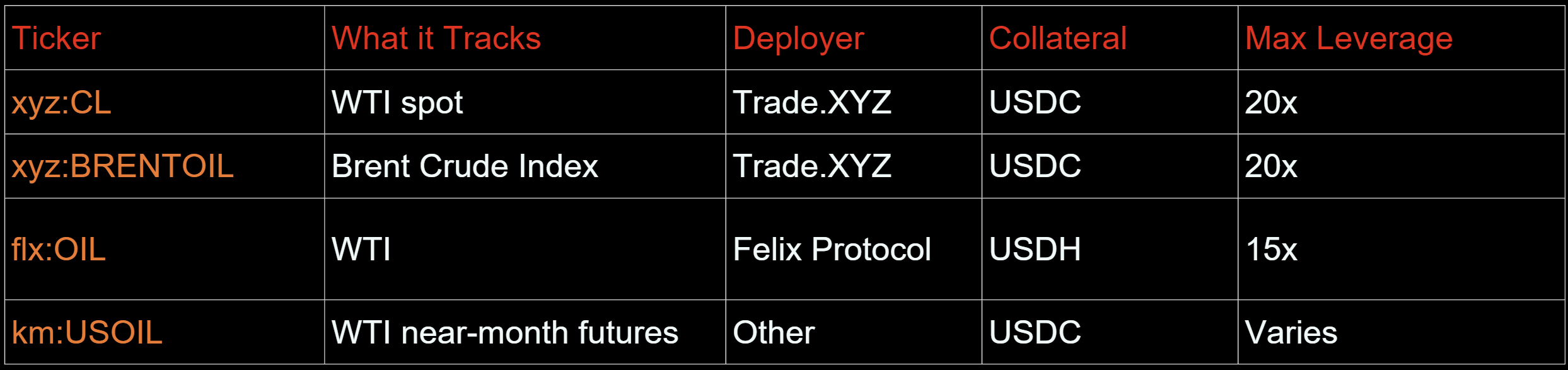
The prefix in each ticker tells you which deployer launched and manages that market. This is important — different deployers use different oracle setups, collateral, and leverage limits.
Key deployers for oil:
Trade.XYZ (xyz: prefix) — The dominant deployer. The HIP-3 contract from Trade.XYZ is now the most active listing, surpassing gold, silver, and the XYZ stock index by traded volume. Cryptonomist Their xyz:CL contract (WTI) is the highest volume oil market on-chain. They also run xyz:BRENTOIL for Brent — currently the only Brent perp available anywhere on-chain. Settles in USDC.
Felix Protocol (flx: prefix) — The original deployer that launched crude oil on Hyperliquid on January 9, 2026. Their flx:OIL also tracks WTI. Key difference: Felix settles in USDH (not USDC), with max leverage around 15x.
Other deployers — You may see km:USOIL and others. These track WTI near-month futures (currently the April contract) rather than spot price. New deployers can launch anytime via the HIP-3 auction system.
Hyperliquid Oil Markets at a Glance:
How to trade it:
Connect your EVM wallet (or use email login)
Bridge/deposit USDC (easy from Arbitrum or native)
Select the OIL, USOIL, or BRENTOIL market
Set your leverage, go long or short
The killer feature: when Middle East tensions escalated over a weekend, traditional futures markets were closed — Hyperliquid became one of the few venues where traders could immediately express views on oil prices. That 24/7 access is a genuine structural edge.
Other perps DEXes with oil markets:
Ostium (Arbitrum) — A self-custodial leveraged trading platform offering stocks, FX, commodities, and index perpetuals directly on Arbitrum, with up to 200x leverage. Ostium uses a pool-based model (not an orderbook like Hyperliquid) and settles in USDC. Good for macro traders who want oil alongside forex and equities in one place. Go to app.ostium.com, connect a wallet or sign up with email.
Extended (Starknet) — A high-performance perps exchange on Starknet offering over 50 markets, including oil, up to 100x leverage, and seamless connection to EVM wallets without needing a bridge. MEXC was founded by ex-Revolut executives.
Gains Network (gTrade) — A classic multi-asset perps platform. Offers WTI/USD perps with high leverage (up to 150x on commodities), alongside crypto, forex, and stocks.
Aster DEX — Lists CLUSDT crude oil perps. Lower leverage limits, but they run trading competitions and incentives. Currently one of the top perp DEXes by volume at around $3 billion.
Storm Trade (TON/Telegram) — The first DEX to integrate Pyth's real-time WTI and Brent price feeds. Native to Telegram, making it the easiest on-ramp if you're already in the TON ecosystem.
Lighter — Offers WTI trading with ~20x leverage. A decentralized trading platform with verifiable order matching, currently doing billions in overall perps volume.
Notable absences: Major perps platforms like GMX, dYdX, and Aevo don't prominently list oil right now.
2. Tokenized Oil (Passive / ETF-Style Exposure)
If you want oil in your wallet without leverage or active trading, there's one main option — but the underlying mechanics matter a lot.
Ondo Finance – USOon
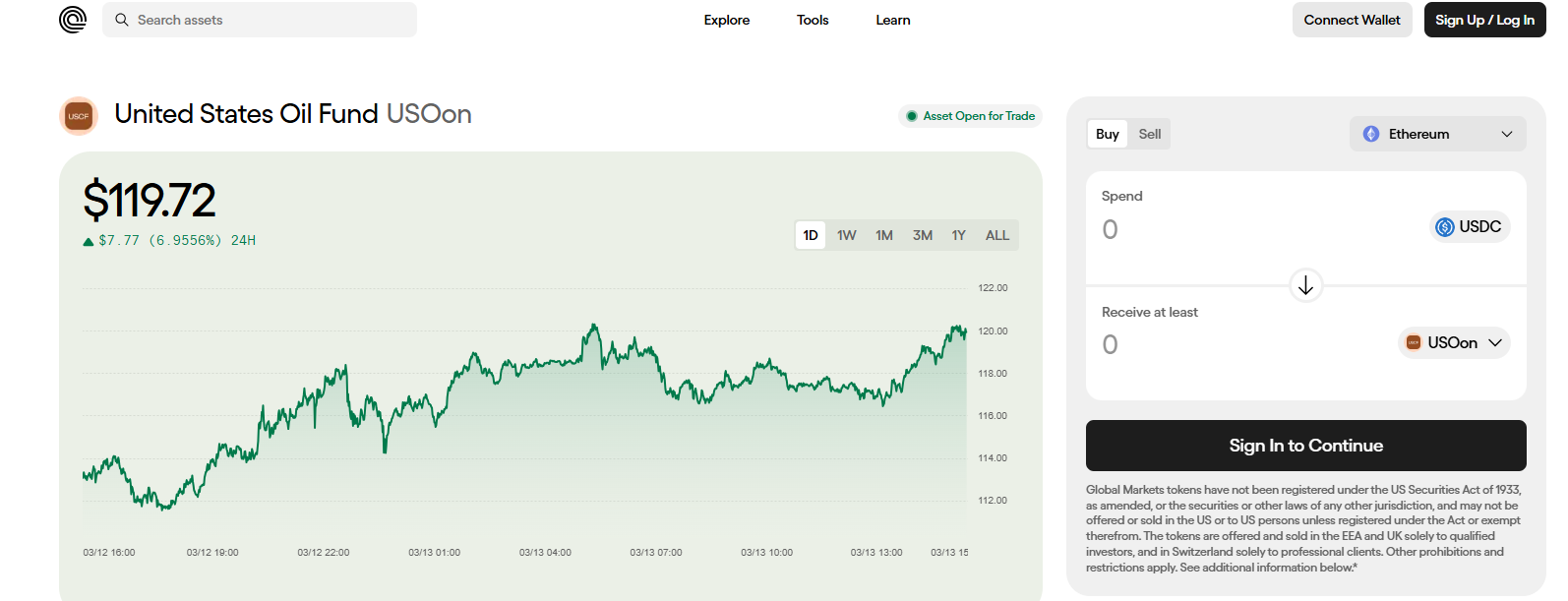
USOon is a tokenized investment product from Ondo Finance providing exposure to U.S. crude oil, issued via the Ondo Global Markets platform.
The most important thing to understand: USOon does NOT track spot oil. It tracks the USO ETF. USO is a futures-based ETF that holds front-month WTI futures contracts and rolls them monthly. The underlying assets are oil futures contracts, not physical oil. Over longer periods, the price may diverge from spot due to roll costs — a standard characteristic of futures-based instruments.
This matters because USO is well-known in TradFi for contango decay — during contango (when future prices are higher than spot), each monthly roll erodes value. Short-term, USOon tracks WTI fine. As a long-term hold, you're fighting the roll.
How USOon handles weekends/off-hours: Since USOon is backed 1:1 by actual USO ETF shares held in regulated custody, Ondo needs to manage liquidity around market hours. Due to U.S. securities regulations, USOon requires KYC/whitelisting and is not available to U.S. residents. Trading is 24/5 (Monday through Friday, aligned with U.S. market hours), not 24/7. During periods of lower underlying liquidity, Ondo applies size limits on minting/redemption to ensure they can maintain the 1:1 backing. This is a fundamentally different model from perps — Ondo has to have enough actual ETF shares to back every token.
Where to get it: LBank, MetaMask RWA integration, or directly via app.ondo.finance.
How Each Platform Handles the "Asynchronous Market" Problem
This is arguably the most important implementation detail to understand. Traditional oil futures have trading hours. Crypto doesn't. Here's how each venue solves it:
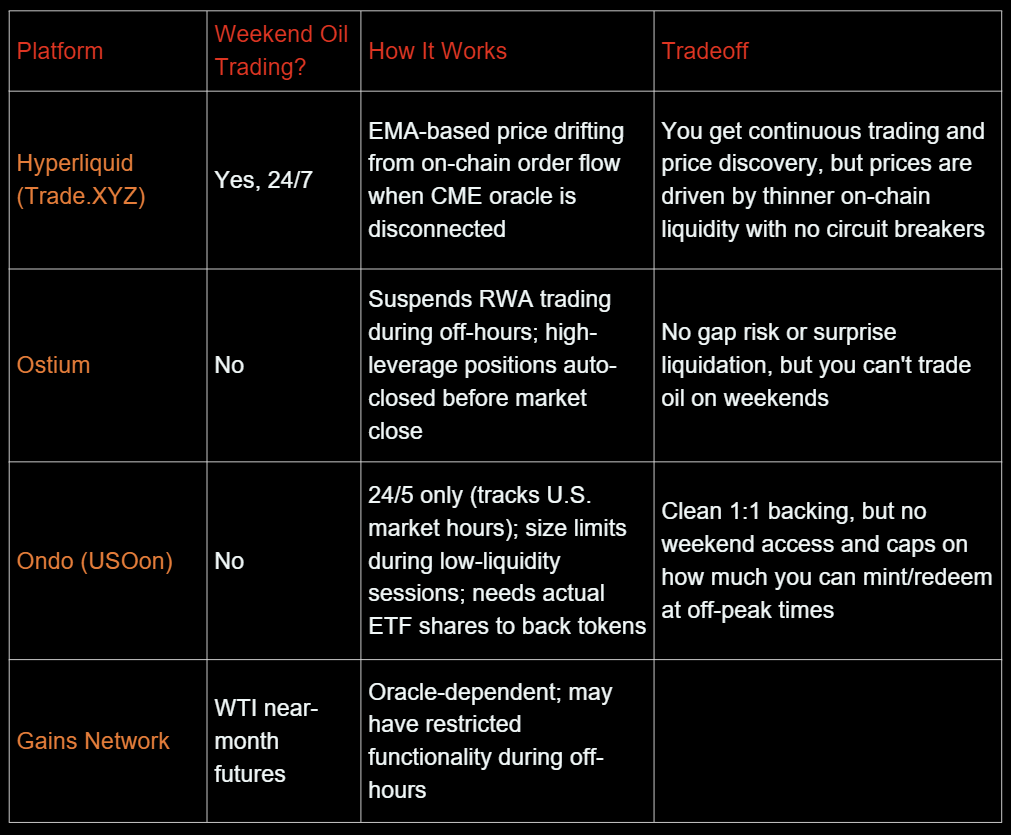
This isn't just a UX difference — it affects liquidations, sizing, and whether you can react to weekend news at all.
So.. How Do I Start?
If you want the most liquid active oil trading, go to Hyperliquid and trade xyz:CL (WTI). If you want to trade Brent Crude specifically, Hyperliquid's xyz:BRENTOIL is currently the only on-chain Brent perp available.
For safer off-hours handling with no gap risk, check out Ostium on Arbitrum.
If you're looking for passive ETF-style exposure without leverage, Ondo USOon is the main option — but note it requires KYC, is non-US only, and tracks the USO ETF rather than spot oil.
For multi-asset macro trading in one place, both Ostium and Hyperliquid HIP-3 work well. If you want to farm points while trading, Hyperliquid's HIP-3 activity counts toward their ongoing points program.
Risks To Watch
Deployer/Oracle risk (HIP-3) — On Hyperliquid, the deployer controls Oracle feeds. Deployers must call setOracle every 3 seconds, with mark price moves clamped to 1% per update. During CME closures, prices are highly dependent on the platform's own order book — and there's no circuit breaker.
Liquidation cascades — Around $40 million in positions were liquidated on Hyperliquid within 24 hours during the March oil spike. Oil can move 25%+ in a week during geopolitical events. Size like you expect to be wrong.
Liquidity can evaporate — Volume swung from $21 million/day to over $1.2 billion during the crisis — 50x range. Calm markets = thin books.
Funding rate costs — Paid/received every 8 hours. On the crowded side of a sustained move, funding gets expensive fast.
Contango decay (USOon specifically) — If you hold USOon long-term, the monthly futures roll inside the USO ETF can erode your returns vs spot oil.
Smart contract/infrastructure risk — These are new markets on newer infrastructure. Not battle-tested through a full cycle.
Regulatory uncertainty — In January 2026, the SEC staff issued guidance on tokenized securities, but the classification of tokenized commodities remains unsettled.